In February, I subscribed to Claude Code Max personally and migrated from Cursor — my primary editor and coding agent — to a VSCode + Claude Code setup. I've been enjoying personal development in this new environment, and I want to write about what I've noticed and how I'm thinking about the broader spread of AI agents.
From Cursor to Claude Code
2025 was my Year One of Vibe Coding. I used Cursor for a full year, built this site, and developed a newsletter feature using Subagents — we got pretty well acquainted.
Then in February, I subscribed to Claude Code Max. I'll explain why later, but first let me describe the experience.
Agent Team Broke My Brain
Claude Code has a feature called Agent Team — a system that runs multiple agents in parallel to progress development tasks.
My first impression when I used it: "poor value for money." It didn't feel meaningfully different from setting up multiple subagents and chaining their workflows manually, while the token consumption was heavy. I hadn't yet gotten the hang of it.
But a few days later, when I actually committed to running it properly, my brain broke.
- First, have it write out all the Issues needed for a product I plan to build. About 40 came out.
- Have it tag the dependencies between Issues.
- Have it plan the work in WAVEs, parallelizing as much as possible with the Agent Team.
- Files that conflict should be isolated in separate worktrees. After writing the dependency tree, a plan comes out to run 5 or 6 agents in parallel per WAVE.
I looked at the plan, and just said: go for it.
Five agents start moving in parallel. An enormous number of approval requests fly in — I click through them without really looking. An hour later, five PRs exist. Unlike when I was managing one agent at a time, I can barely track what's happening at all. But output is being produced. I tell it to merge in the correct order once CI passes.
Then the thought hits me: wait — am I even necessary here?
The Limits of Parallelism Are the Same as Human Team Development
That said, running five Issues in parallel doesn't mean it's five times faster than running them serially. I'd estimate it's roughly 20–50% faster — not 5x.
You can end up spending as much time resolving conflicts across five PRs as you saved. And I noticed: this is exactly the same as human team development.
When you scale headcount but everyone's working in the same files and repository, conflict resolution and adjusting your own work in light of other branches' changes become inevitable tasks.
The orchestrating agent has some sense of management and direction. But looking at the actual PRs, there are plenty of things it failed to manage — again, just like a human team.
In the end, the most efficient setup is: someone (or a team) who can work through tasks serially with high precision and speed, owning a project that's entirely independent from others.
It's ultimately a game of minimizing overlap and interference.
Why I Moved to Claude Code
Cursor is an excellent product. As a GUI-based editor, it seamlessly integrates AI interaction into the coding experience. As an entry point to AI coding, no other tool has a broader on-ramp.
But in my case, most of my coding work happens in the terminal — git, npm, debugging, all of it. Claude Code lives in the terminal, so I don't have to leave where I already am. Not being tied to a particular editor is something I genuinely appreciate.
As I wrote in a previous post, tools only become second nature when you use them deeply.
Having used Cursor for a year, I'd built a sense for "if I explain it this way, it works" and "here's where I need to decide myself."
With Claude Code I'm climbing that same learning curve from zero, but the model — Opus 4.6 — is so good that I can just hand everything to it.
Cursor's multi-model setup sometimes required switching between models based on rate limits, and quality could drop noticeably. With Claude Code, that doesn't happen.
The "Place" in Coding
Beyond feature comparisons, the difference in where the tool lives feels even more significant.
Cursor is proposing a new home — a new editor to inhabit. That's also a significant constraint on your location.
Claude Code doesn't care what editor you use. It strengthens where developers already are. Instead of moving you to a new place, it upgrades the place you're already in.
Whether you can complete your tasks from within the same familiar space you've always worked in — that's the most important factor, given that humans hold the power of choice over the tools they use.
AI Agents Are Competing on "Where" They Live
This structure isn't limited to coding.
For business professionals, the "place" is Slack, Notion, Salesforce, accounting software — the de-facto systems where daily work happens. The vast majority of daily tasks live inside these tools.
When AI agents enter this picture, getting people to learn and use a new tool is an extremely high bar. Asking already-busy people to take on the learning cost of a new UI is not realistic.
Especially in Japan, where business culture tends to be slower to adopt new things, mass penetration of entirely new tools would be extremely difficult.
So I expect AI agents to spread by moving into the places where users already are.
- AI lives in MS Office
- AI lives in Google Workspace
- AI lives in Slack
- AI lives in Notion
- AI lives in Salesforce
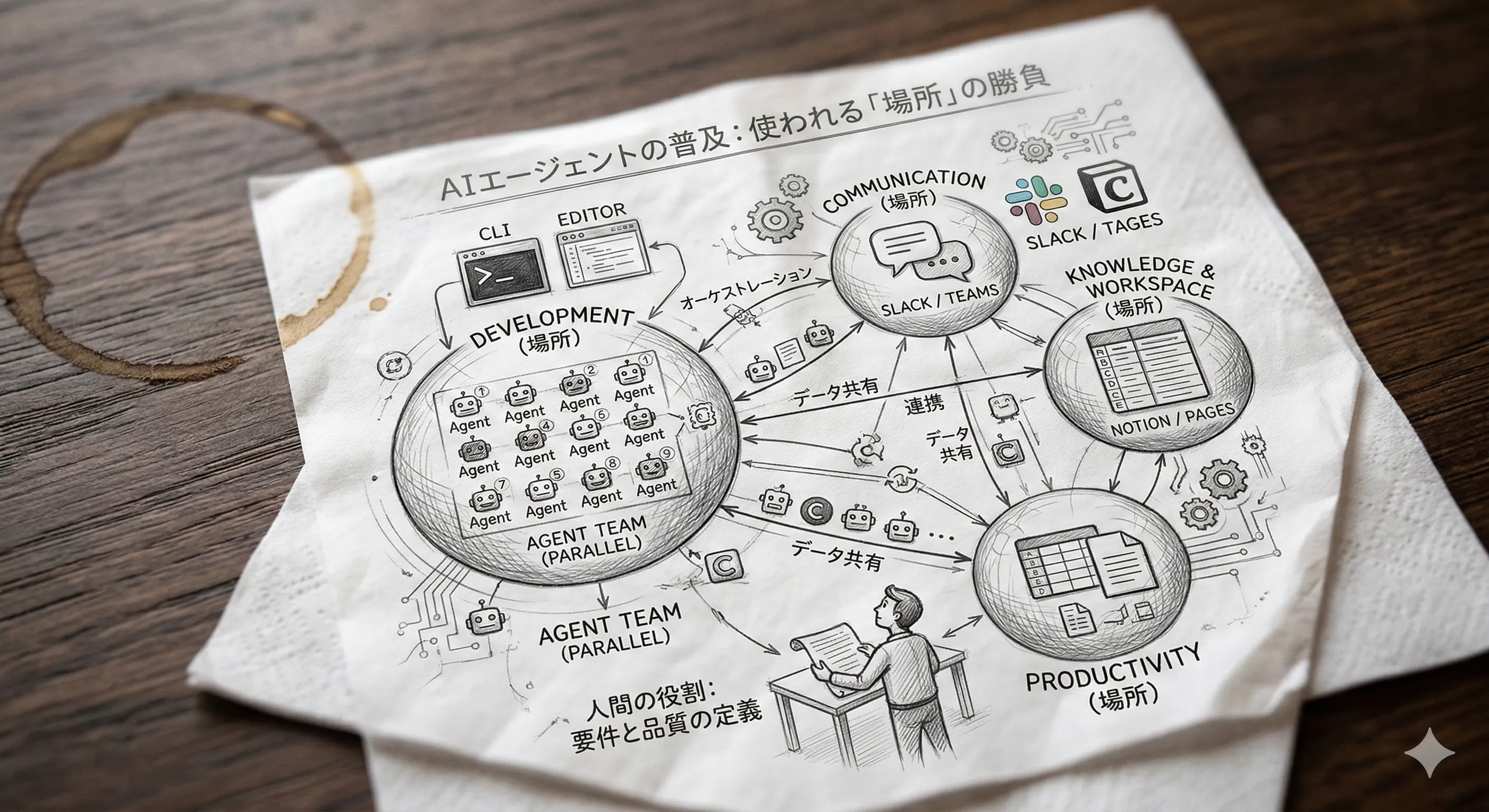
AI agents have a quality of further entrenching de-facto systems. Strong systems get even stronger through AI, and weak systems become relatively weaker. The idea of AI-native newcomers displacing de-facto tools — at least in Japan — feels harder than people might think.
Notion Will Continue to Grow
One personal prediction to close: I think Notion's growth still has a long way to go.
They acquired users through PLG (product-led growth), converted to SLG (sales-led growth) to expand into enterprise, and now have a presence across organizations of all sizes. Most recently, Keio University adopted it campus-wide — making it the OS that the next generation of business professionals will touch at an earlier and earlier age.
For these students, Notion could become their first AI touchpoint.
I've actually started using Notion's custom agent myself since the end of February. I set up a system that automatically generates a weekly report of team activities — and the setup was remarkably simple. The data was already in Notion, so there was almost no friction in connecting it. That is the power of "place."
Founder Ivan is not just a product builder — he's someone who can create large-scale shifts in GTM and market dynamics. I see real potential for Notion's moat widening further in the AI era. Documents, databases, and project management in one place, with AI built in. Because the information is already there, an agent can deliver value immediately.
In Closing: What Humans Do Hasn't Changed
I've been rambling about AI agents, but even as I use more and more of them, my own stance remains: "necessity is the mother of invention."
AI lowers the threshold for invention, but the people who cross it were always a small group of people who wanted to cross it.
And even among those people, very few have a firm grasp on genuine "necessity." In relative terms, the people who can correctly define and hold onto "what's actually needed" are getting stronger.
As I touched on in a previous post, clarifying requirements, making architecture decisions, and setting quality standards remain important human responsibilities.
No matter how smart AI gets, deciding what to build, to what level of sophistication, and judging whether it's sufficient — that's the human's job.
If anything, I have a feeling that as AI spreads, that dynamic only intensifies.