On December 20, 2017, I issued my first-ever press release, and a few media outlets published interviews with us.
This blog captures thoughts I couldn't fit into those pieces, loosely and ramblingly. It's long again — as usual — so please read when you have time.
Make Something People Want
I want to stake my life on "building products that people want."
I have a habit of constantly picking up and touching new things — physical products, apps, web services, IoT, commodities, securities, whatever. Every day, without fail, something new. And through each product I touch, I try to imagine the maker's view: "Who is this for? What problem does it solve?"
I also frequently notice "things I struggled with" or "things people close to me struggled with" in daily life.
I don't have a particularly sharp antenna. I just don't overlook the small observations anyone could have. For a problem I notice, I imagine: "What if there were a product like this — could it work?" Ideas go immediately into text. Challenges I want to tackle accumulate that way. "Real problems that exist." "Distortions in the market." "Signals from the world." When I find the intersection of these, I want to start building immediately. I want to call people and say let's do this together. My imagination fills with the world after the product exists.
The pain of creation that comes next, the pain of growth — none of that matters. The process of running experiments over and over, groaning over failures, and continuing to create — that's what excites me. Since the 2011 earthquake, afraid of "dying tomorrow," I've been spending time only with the family I love, someone "without hobbies and thin social connections." For that kind of person, "products" are the first hobby and reason to live I've ever found. When I say this, I might get in trouble with our investors — but I'm approaching it not as "work" but as "a hobby I'm staking my life on." I love it, I enjoy it, so I do it.
10X, Inc.
July 2017. I invited my Mercari colleague Ishikawa @_ishkawa and we started a company. I had several ideas I wanted to try — intersections of the right problems — but more than that, it was the desire to build something big with someone whose sensibility transcended the engineer role. At Mercari, Ishikawa and I would often go out for coffee together. We clicked on pursuing "people's problems."
"If Ishikawa and I team up, we'd at least hit maybe one in three times. If we can swing three times, the specific idea doesn't matter that much." That was my optimistic take. Visionary Companies also says "choose the crew first, then decide the destination." A project I'd been working on at Mercari wrapping up was also a push. Having a second child was an even bigger push.
Having to decide when to leap into another startup while raising a newborn second child — I remember feeling anxious. Being inspired by a junior Mercari colleague, Ide-kun @niconegoto, who was always moving forward while I was giving him advice — that was another spark. Many triggers aligned, and I — someone who tends to decide quickly — made the decision to start the company. Or rather, I was made to start it by everyone around me. My wife put up zero resistance: "You're going to do it anyway." End of story.
After registering, we went through two name changes and landed on 10X. A boss I had at Google often said "think from 10x — creating ten times the value." I liked it and put it in the company name. "We want to implement 10x value in society" is the meaning we attached — but that was post-hoc. It wasn't formally established as a mission. But the words sit comfortably. They may become the official mission as-is.
What did I want to do? I'd thought about and discussed it on various occasions, but I had no particular attachment to a specific problem or product. But there's a phrase that occupies my mind: "Something people want." Something no one can quite put into words, but when placed in front of you, makes you say "this is exactly what I wanted!" — that's the product I want to build. That was my honest motivation. The product Tabery, which I'll describe later, is the first attempt at that. 10X's first at-bat.
There's a recurring question I ask myself: should 10X aim to be "big"? I keep searching for the answer like a Zen koan, but no clean answer comes. Both yes and no feel complex. But this question isn't one to answer by comparing ourselves to the fastest-growing things in the world or past growth industries. Today, Bitcoin provides a good point of comparison.
"Even if we don't bring economic value to match Bitcoin's market cap, I want to radiate irreplaceable use value to the people I've identified, and to the people who pick up the product." That feels like enough of an answer for now.
Team members joining
November 2017. Ishida-san @wapa5pow — a "very strong engineer" who had fought massive social game traffic at Gree and gumi — joined. We'd worked together before, and I had strong trust in his approach to products and his work style. Becoming a three-person team dramatically increased our speed. The two Ishis — Ishikawa and Ishida — are already my proudest weapon. I'm confident that as long as I don't misjudge direction and handling, it's a drill that will definitely strike something big. That straightens my back — I need to keep finding teammates and building an organization that linearly accelerates the drill's speed.
The origin of Tabery
Late November 2017. We released an app called Tabery.
The concept for Tabery originated from problems I noticed during paternity leave I took when our second child was born in May 2017. Taking on all the household duties for exactly 30 days, I found an abundance of "daily burden" that erased all the joy of parenting.
It didn't take long to realize that the source of burden was the "decisions" demanded every day. Especially deciding the week's meals and deciding what to buy — those two were particularly painful. Searching Twitter, I found many others with the same struggle. A lot of the highly-retweeted posts were from men who had gotten more involved in the household.
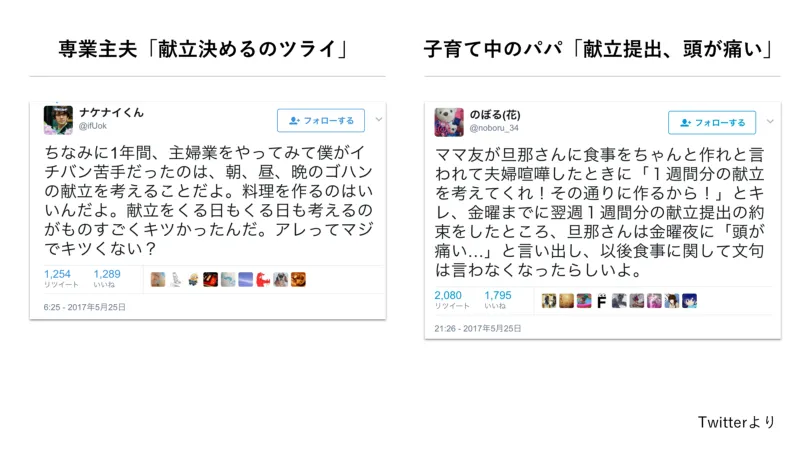
It was so painful that to make my own life easier, I created "a Slack bot using Google Apps Script that automatically decides the week's menu and the ingredients needed every Saturday morning and sends them to me." That was Tabery's beginning.
When I tweeted about completing it, there was a lot of response, and a few friends I gifted it to were delighted. When I tried selling it on Coconala (a Japanese skill marketplace) for 5,000 yen, it sold almost immediately — which made me feel the problem's existence, breadth, and potential as a service. (At this timing, Ishikawa and I started building it as an app on the side.)
There was another personal reason I chose "meal planning" as the theme. The 2011 Tohoku earthquake. I was living in Sendai at the time, and when the infrastructure was cut off, I spent several days in a shelter. During that period, I developed PTSD-related symptoms and couldn't sleep.
What started my recovery was cooking. Going back home from the shelter and eating my wife's cooking was what restored my sense of peace and gradually brought sleep back. Since then, I'd known: cooking is a "symbol of the everyday."
On market selection: the fact that there's a massive, underdeveloped market behind cooking — "purchasing fresh food" — was also decisive. For households like mine where time is relatively precious as children are born and we age, many people are "looking at flyers, spending an hour at the supermarket, and maybe wasting a third of what they buy" — that can only be some kind of distortion. More than enough of a problem to roll up my sleeves for.
- "A problem that genuinely exists for people"
- "Market distortion and timing"
- "Reasons why we're the ones to do it"
Looking back, Tabery may satisfy all three. Of course I didn't frame it this way when I first noticed the problem. But the problem itself was what Paul Graham would call an "organic idea."
Observation and experiment
How was Tabery built? And how will we continue building it? Through "observation and experiment." I have no intention of ever changing this.
As I mentioned, the first business validation was done by selling "I'll decide your meal plans" on Coconala and Jimo-tee (Japanese local classifieds). More than 10 people paid immediately — enough validation. We moved quickly to product validation. From there, it was daily visits to users' homes, relentlessly engineering "how people think."
- In the morning, I'd go to a user's home, hand them the actual device, and have them try the app.
- I'd record their behavior and expressions on video, interview them on their thinking and friction, and take notes. In almost every case, the experience was nowhere near smooth.
- Share with Ishikawa. With urgency.
- In the afternoon, work out specs; in the evening, implement. At this stage, Ishikawa's terrifying implementation speed guaranteed the velocity of our validation.
- The next day, go test with a different person.
This was the cycle we repeated every day.
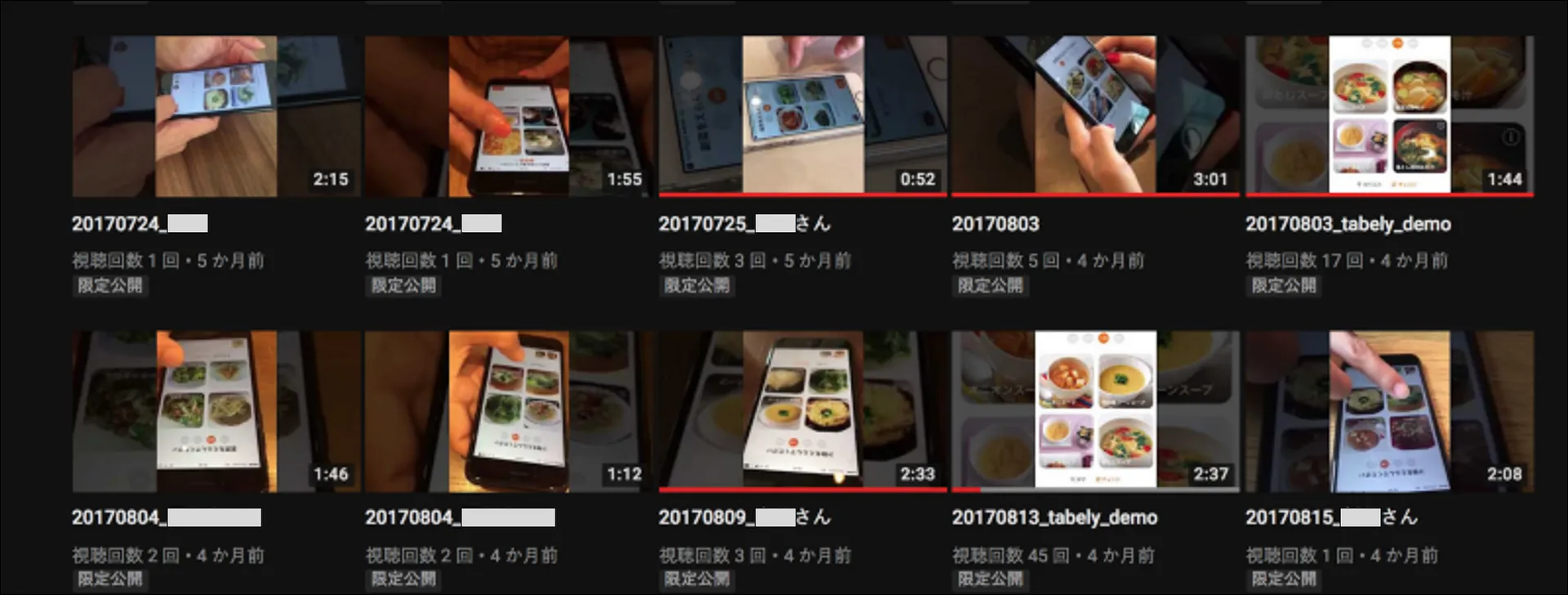
There's actually not a single case where we directly reflected "what the user said" into the product. We weighted "what they did" over "what they said." Testing mattered more than interviews or hearings. Because what people want is what they can't yet articulate. An inventor's job is to observe human behavior and find the negative within it.
This flow continues even now that we've launched. We meet users like breathing, and get thoroughly beaten up every time.
Of course, we have data points instrumented throughout the product and can immediately visualize KPIs — we're confident in that capability. But at the 0-to-1 invention phase, getting insights from numbers tends to take too long. Being at users' sides gives us a flood of insights about the problem; numbers serve as the tool to verify those insights. That's the positioning now. The right positioning for numbers changes by phase — getting that wrong matters most.
Unfortunately, Tabery has only delivered about 1% of its potential. I believe there's room for 100x improvement in value. We need to keep challenging intuitive information architecture that thoroughly replaces people's thinking. Stay at users' sides, don't neglect observation. And don't give up on articulating and expressing it. That's the kind of building I want to keep doing.
The inventor community
Before founding the company, I was collecting essays on building products on my Blog. Most were directly tracing Paul Graham of Y Combinator's thinking, and alongside my own experiences, challenging myself to put thought into language. (Each piece requires considerable energy even now — but since it's an expression of thoughts about products I love, I can't escape it.)
Fortunately, in 2017, many people reached out for meetings after reading my writing. Most of them were young entrepreneurs in their early 20s. One of them was shosemaru @shosemaru, who recently has been building a product called Talkroom that replaces LINE calls for middle and high school students. Actually, I hadn't been aware of him until recently — but I came to know him because he spread Tabery to a mass audience on Twitter, far beyond what our own press release did. I'm grateful, but I settled that debt with 1,000 yen of Korean food — meaning I've incurred a lifetime debt where his future advice requests will always weigh on my conscience.
↑ The legendary tweet that generated over 6,000 retweets
There are many types of entrepreneurs, but in my experience those who truly want to pursue a product to its depths are not many.
Among those few, he is — contrary to his flashy appearance — the kind of product entrepreneur who is absolutely at users' side, calmly aiming for invention. He goes out to Shibuya every night, approaches high school girls to conduct user interviews, quickly builds those insights into the product, and experiments again. His approach overlaps significantly with mine.
Carrying the same risks, facing products and users in the same way, trying to present change to society. Having one, two people with psychologically proximate positions gathering around you — I'm experiencing how much it makes the heart light up. POOL's Taku @gittaku was the same way.
Products carry the maker's colors. Even if two people capture the same problem, the creator's context is always included, and no two products turn out the same. Learning from young inventors while remaining "a representative of people like me" — I want to build products that include my context and radiate 10x value.
Inventors are often isolated except from their team and customers. That's because "they're pouring abnormal energy into problems only they could notice." From a sensible third-party perspective, that looks like "wasting time" and tends to attract criticism.
I believe investors, for example, should always be supporters who stand beside inventors. pstlm @pstlm, on Twitter, repeatedly posts about alcohol, women, and criticism of critics — a mysterious account of unknown identity — but actually has remarkable courage to genuinely believe in the problems inventors see. I'm confident that the next generation's inventor community will form around entrepreneurs like those I've mentioned and people like him. And it actually is.
Day One
I love the phrase "every day is Day One" — something I often heard from my coach during my American football days. Today I use it with two personal meanings.
First: I want to make someone's first day the best possible. Every product has new users arriving every day. Every day is someone's Day One, and the first impression decides everything. See it, feel it, use it immediately, feel the value. Only products like that have the right to be loved. Am I delivering a product that gives love rather than disappointment to "the whoever who picked it up?" I feel urgency every day at the gap between reality and the ideal, and want to keep closing it.
Second: a phrase that disciplines me. I reflect on what my state of mind was when I approached Day One of any given thing. At every Day One, there was strong anxiety and expectation — and I was preparing to eliminate the anxiety.
- Am I approaching today with the same tension as Day One?
- Have I advanced far more than Day One?
For someone weak-willed like me, words that daily pass through my mind to keep me from living too comfortably. As a declaration of intent to keep working without forgetting Day One as someone who provides products to people — I'll put down my pen here.
If I lose sight of Day One, please beat me up via Twitter replies.