This is a translation of "Startups Serving The Enterprise: Navigating the Quest for Successful Innovation" by Sarah Guo, Partner at Greylock, originally published July 28, 2018. Translation and publication rights obtained.
Original article: Startups Serving The Enterprise: Navigating the Quest for Successful Innovation
Startups Serving The Enterprise
At Greylock, our CXO Program brings together top enterprise leaders to discuss technology trends with our investment team and to facilitate meetings with our portfolio companies. This program developed in response to a wave of interest from large enterprises that want to adopt emerging technologies and buy from more innovative vendors. Through the program, we've had the opportunity to meet with hundreds of C-suite executives and buyers across industries.
Why are large enterprises so interested in startup technology? Survival. Every company is undergoing digital transformation. Visionary executives see the pace of business change accelerating. They know that companies that adopt advanced technology faster will run their businesses better, faster, cheaper, and smarter. Technology is a weapon to protect against competitive threats and gain and maintain market advantage.
Similarly, startups selling enterprise technology must understand how to work effectively with large companies to survive and succeed. Within large enterprises lie employees, data, workflows, industry and institutional knowledge, assets, customer relationships, intellectual property, and budgets.
However, we've found that even startups focused on enterprises, and even their "early adopter" customers, often struggle to work together. Almost no technology leader says they don't want to innovate. And almost no startup says it doesn't want to help large companies. Yet the barriers to innovation are real, and if they can't be overcome, they mean irrelevance for enterprises and rapid death for early-stage startups.
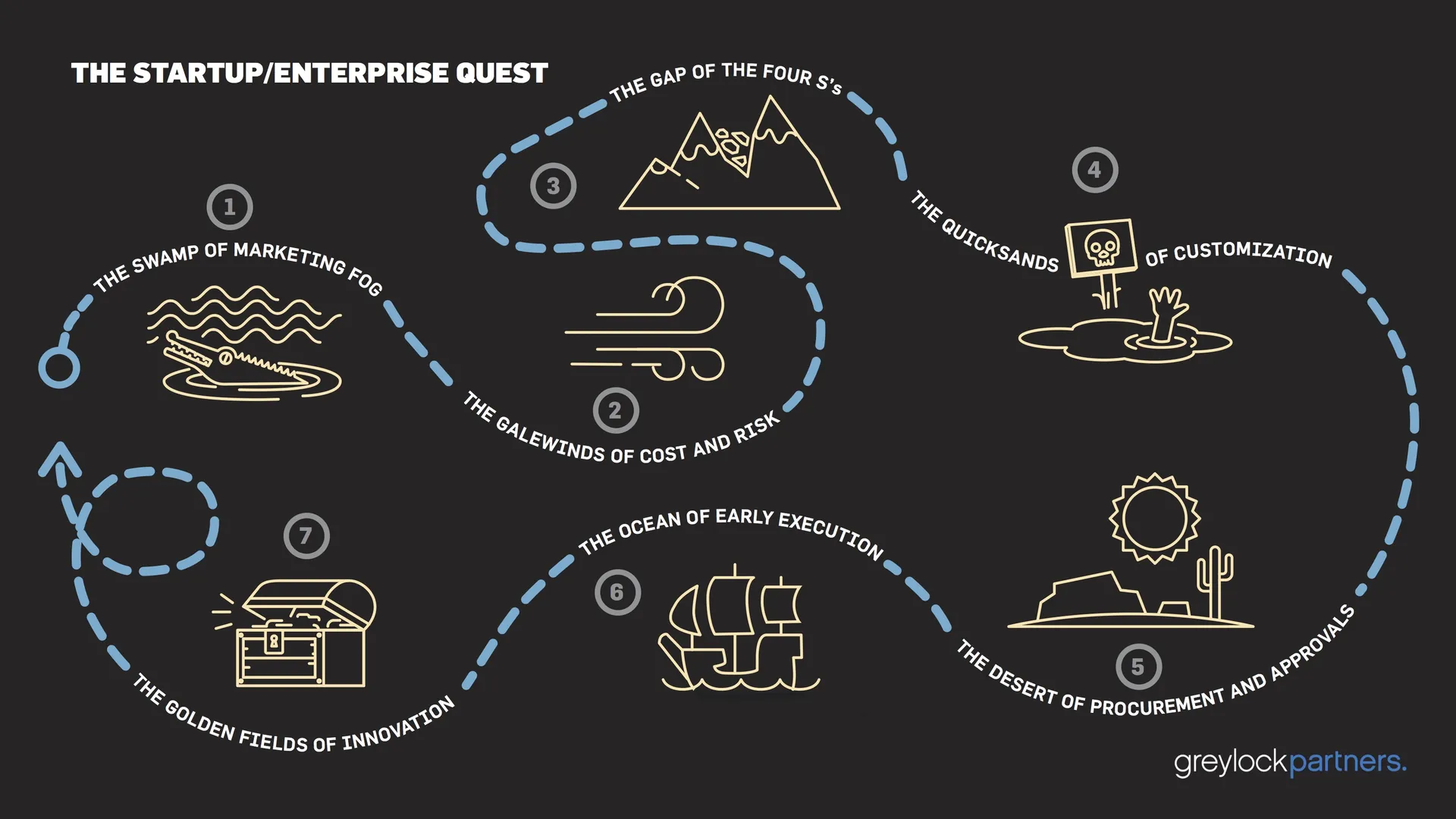
To turn patterns of collaboration into strong know-how, we conducted extensive interviews with Fortune 500 C-suite technology leaders, CXO Program participants, and startup founders and CEOs in the Greylock network. We drew a map to guide the common challenges that startups and their customers must navigate together.
Here we present findings from an enterprise summit presentation covering some of the key discoveries. If you want to share feedback or your own exploration stories, contact us at LinkedIn, Twitter, or sarah (at) greylock.com.

1. Recruiting partners through the marketing fog swamp
Before enterprise executives and startup founders can set sail together, they need to identify the right partners. Startups often feel they need to shout through a foghorn, while enterprises are bombarded by a storm of marketing noise. When the market is crowded and executives are busy, recruiting quest participants is difficult. Our community offered three suggestions for escaping the swamp.
Shine a bright light
Warm introductions can be essential. In addition to strong analyst support and unique PR coverage, enterprises report paying attention to companies referred by VCs, peers, and other trusted opinion partners.
For example, a launch plan that doesn't overwhelm the partner, the ability to utilize existing budget, meaningful success metrics that can be evaluated quickly. You need to quickly understand what the customer cares about and pitch accordingly, while remaining faithful to what your solution can actually deliver. One challenge is that the market is very noisy, and it's hard to get customer attention. The best is a warm introduction. Ideally from someone in your network who will truly fight for you. That can make all the difference in the world. — David Ebersman, CEO of Lyra Health
Enterprises also look for vendors that have customers close to their own scale and industry.
For any company, I focus on their delivery track record. And as part of that, I'm always interested in understanding who their customers are. Having the right names on that list can go a long way in speeding up the process. — Diana McKenzie, CIO of Workday
Draw a clear (and easy) path
Startups need to clearly articulate the problem they're solving, their value proposition, and differentiation. Marketing messages only become clear when enough customers find them clear.
Whether it's a startup or an established company, when I focus on new technology, it has to meet an unmet need. We're not interested in technology for technology's sake, but I want to know: does this do something new that's useful for our business? Does it increase productivity, save money, or can it replace something existing that's more expensive or less functional? — Marc Frons, CTO of News Corp.
We're looking for products that solve a clear problem. We're a mid-size enterprise, and we don't have the luxury of doing many experiments that are "cool but don't meet an immediate need." The next consideration is integration difficulty. How hard is it to roll the ball and implement the technology in the broader ecosystem? We like companies that know where they fit compared to current vendors. — Michael Baresich, CIO of Ally Financial
Seek the right stakeholders at the right time
For some startups, CIOs, CTOs, or Chief Digital Officers can be good channels. In a noisy era, leaders drive team strategy and focus. However, many of these leaders say they're not the final decision-makers themselves. Leaders lead the technology organization and create air cover for the team, but much of the decision-making (and purchasing) authority is distributed. Decision-makers include CIO direct reports, heads of application development, business unit leaders, security heads, departmental VPs, and even end users or developers who buy business software with a credit card. And these technology professionals and leaders are structurally more proactive about adopting technology than CIOs.
As CIO, I empower my team to make purchasing decisions based on their goals. I don't make those decisions unilaterally, and I rarely exercise veto over decisions the team has made. — Ted Colbert, CIO of Boeing
Involving many people in new technology is essential, and ultimately finding the right combination of technology deployment and actual use areas greatly helps technology adoption. For example, when considering new cyber technology, it was necessary to involve not only the appropriate technology team, but also members of operations and infrastructure teams, and to consider whether legal and audit involvement was needed. This is because most valuable tools need to cross several organizational boundaries within IT, and between IT and the company as a whole. — Rich Adduci, Advisor at Esito LLC, former CIO of National Grid
This starts with the CIO, and that's usually the first entry point. But the real influence usually lies with other leaders within the organization — people the CIO relies on to guide technology decisions. If a startup can build relationships with these leaders, that's often where you can be most successful. — Diana McKenzie, CIO of Workday

2. Maintaining faith through the galewinds of cost and risk
Even after your team has secured a way out of the swamp, it can feel like fighting galewinds. New products must provide enough value to overcome the inherent costs and risks of working with startups.
A technology leader at one enterprise said that when he talks to his team about adopting new technology, it inevitably triggers an immune defense response.
When I go out, see new technology, come back, and talk to my team about adopting it, there's a phenomenon where a kind of immune defense system kicks in. Not because they dislike me or the new technology, but because their own priorities and risk tolerance conflict with the new technology I've brought back… Getting adoption is difficult. What I've found useful is taking a cross-functional section of the team (beyond levels and functions) when visiting Silicon Valley, to stimulate interest and boost engagement. If they see and touch the new technology with their own eyes, meet the founders, and believe it has promise, they can pull it into the organization for me, and I don't have to push it. — Rich Adduci, Advisor at Esito LLC, former CIO of National Grid
Startups need to empathize with this risk aversion and understand that someone's career is often on the line on the customer side.
New vendors need to understand how customers measure return and cost. If you're on different pages about this—for example, if the enterprise measures ROI differently or more narrowly than you do—you'll run into trouble down the road.
We were selling on infrastructure, and it didn't resonate with most people. So we adjusted our message and focused on simplicity and the impact that simplicity has on reducing infrastructure management costs and headcount. We asked for a list of goals, and asked how many of those goals were being achieved with current spending. Customers quickly realized that a large portion of their IT costs were going toward infrastructure challenges and management, not toward achieving business goals. So we pursued simplicity, removing infrastructure challenges so customers could shift funding toward business goals. — Chadd Kenney, VP & CTO Americas of Pure Storage
Our service can help companies reduce costs in a variety of ways. It's important to ask early in customer meetings what problems are most pressing and how customers define and measure savings. — Chris Cook, CEO of Delphix
Enterprise customers also told us they think about the "hidden costs" of vendor management, user training and adoption, integration, implementation, management, and the risk that the startup will die or be acquired.
What startups don't understand is that while you might easily have the budget for a $100,000 contract with your company, it literally costs $200,000 to evaluate, onboard, pay for, and manage a new vendor. My people's time is precious. There are enormous hidden costs, so it has to be important to take them on. Nice to have doesn't work. — SVP Technology, Fortune 10 Bank
When choosing a startup, we do quite a bit of financial scrutiny. What's their funding situation? How much are they currently raising, and who is backing them. It tells you a lot. — Ravi Malick, CIO of Vistra Energy
Because of these many "hidden" costs, smart technology buyers are looking for startups that predict their customers' moves and not only provide tactical benefits, but also have a chance to survive long-term as partners who disrupt existing categories or create important new ones.
I want to see how a startup functions in the platform space. Otherwise, you're just waiting to be acquired and become part of a broader portfolio, which is a big risk for me. I'm trying to understand the startup's ultimate goal—are they thinking about customers like me, or are they trying to build a solution for a large company? — Bijoy Sagar, CIO of Stryker
The benefits for disruptors include innovations in purchasing, technology use experience, and total cost of ownership.
We spent a lot of time understanding all the challenges of buying products from [legacy] companies. In storage, customers buy the same array every 3-5 years. You couldn't get trade-in credits or maintain gear without dealing with cost increases. Maintenance costs more than buying new. We changed that model and introduced Evergreen Storage, a seamless business model that transformed the industry. — Chadd Kenney, VP & CTO Americas of Pure Storage
Enterprise tech leaders want to work with startups that have raised funding from top investors to reduce risk.
I rely on insights from quality VCs like Greylock and referrals from peers to find startups. There are lots of "me too" startups out there. There are too many to sift through on my own, and the analyst community I've relied on for years doesn't typically include innovative startups in reports. Greylock's ability to pick technology that matters to me as a CIO and can also win as a business is unmatched in Silicon Valley. — Rich Adduci, Advisor at Esito LLC, former CIO of National Grid
CIOs need assurance that you (the startup) won't go out of business, get acquired, or disappear. This is to reduce risk, because most startups end up that way. Many Fortune 500 CIOs hesitate for exactly this reason. — Michael Keithley, CIO of United Talent Agency
When enterprises work with early-stage startups, they often worry about company viability and long-term technology sustainability. It was important to emphasize having strong backers with a track record of funding innovative companies that have successfully disrupted existing markets before gaining a significant number of customers among Fortune 50 companies. — Amit Pandey, CEO of Avi Networks
Another important theme was the need to build personal relationships with early customers and demonstrate commitment to partner success.
For early startups, it's very important for senior leadership to be personally involved, even if not the CEO. Personal involvement and commitment helps overcome concerns about the company's ability to scale. I want to know your mobile number, that I can call anytime, and that you'll marshal the resources needed to make the technology successful. — Otto Chan, EVP of Wells Fargo
Two things I always tell all our customers to overcome hesitation about working with a startup—first, acknowledging that something won't work. Legacy players and others don't say that. And second, that we're here to respond to it quickly and transparently. Because things can go wrong with technology. Acknowledging that and saying "we're here supporting you" will be more effective. As a startup, you have to get enterprises to accept that you "are there for them." In reality, startups often support enterprises better than legacy companies, because you're their first customers. They're all big fish for you, as opposed to another, old, large enterprise—Salesforce releases software 2-3 times a year, and if you need some features, take a number. We release weekly, and if a customer needs something, we can do it. — Joseph Ansanelli, CEO of Gladly

3. Bridging the four "S" gaps: Scale, Security, Spend, Support
After fighting through the galewinds, you reach the four S gaps—and this is often a rude awakening. The value may outweigh the costs and risks, but will the product work in an enterprise environment? Startups can reassure enterprise leaders by demonstrating they understand the world beyond Silicon Valley. We see these four core problems come up repeatedly.
Scale
Can the startup support the customer's user base or infrastructure scale? Customers increasingly want to verify scale rather than take it on faith. "Scalability" is defined not just technically, but in terms of real deployment—can the software process transactions quickly, can it handle thousands of simultaneous users? This includes ease of use, rollout plans, reporting, integration with existing technology, management workflows, and SLAs. Customers are also evaluating who will help with deployment—the quality and existence of the startup's sales engineering and implementation teams.
Startups often overlook how complex the environment becomes in a large organization. We have 120 country offices worldwide, with many layers, and startups typically don't understand this complexity. I think it's difficult for them to figure out how to bring their technology into an environment like ours. — Stephanie von Friedeburg, COO of International Finance Corporation
These small companies spend time selling their great technology and what can be done with it. They should be communicating how easy deployment to legacy environments is, not looking down on those with legacy environments. Our most modern system is 12 years old. It's not just banks. The mismatch between startups and enterprises is the biggest barrier. — Thomas Nielsen, Chief Digital Officer of Deutsche Bank
Security
Security was cited as the top concern by startup founders—and it came up in every single CXO interview. The need is often driven by regulations like GDPR and internal requirements for stringent access controls. What matters here is having a clear approach to customer data: where is it, who owns it, who manages it, and what protections are in place? What vendor risk does the startup itself pose? Startups should proactively get "security checklists" from large potential customers early and address them aggressively.
We've seen startups fail repeatedly on security and resilience. And it's not something we can choose—it's a regulatory issue. — CIO, Large Public Payments Company
Many [large customers] will run extensive due diligence. Being able to pass that shows you're ready. — Robert Kim, Co-founder of Ritual
Spend
A pricing model that works for your first 30 developers or first 100 users may not work for broad deployment. Startups must offer pricing models that are viable at scale and align with the value they create for customers. One Fortune 500 retail CIO shared that there are organizational reasons why his team can't charge new software to a credit card, even though some startups prefer that. For accounting rules, technical sprawl, and compliance reasons, customers need purchase orders—startups that support seamless purchasing workflows have an advantage.
Support
Is the startup prepared to provide the kind of support enterprise customers need—often 24/7—at scale? Can you handle the reality of legacy technology that large companies often have, and guide customers to success?
Startups that proactively investigate and close the four S gaps will have better odds of success.

4. Avoiding the quicksand of customization
Customization quicksand is a particularly tricky area. When you're solving one problem for a customer, it's easy to want to solve all problems. But getting caught up in customization can mean the death of a company, or at least a derailment.
Just as customers choose to work with specific startups based on extensibility, durability, and other factors, startups should carefully choose their early customers, balancing strategic priorities and limited company resources against customer requirements. Being too permissive with strategy, or not following through on strategy, can lead to mediocrity across multiple categories. As Frank Slootman, former partner and CEO at ServiceNow, often said: most opportunities are also threats to your focus.
Relationships often matter. Build chemistry with the CIO/team, execute reliably, but be able to push back. Trying to respond to every customer request, or trying to solve every problem, is a disastrous strategy for startups. I'm favorable toward entrepreneurs who say "Oh, great feature, but we can't do that." That's a meaningful dialogue for us too, since we can be wrong. If that leads to better solutions, it can change our thinking rather than trying to jerry-rig existing technology, and we can learn from the startup. Balance is also important. — Naveen Zutshi, CIO of Palo Alto Networks
Customization and customizability is the important pushback we get. We're a high-speed platform, so we can't fully customize everything. Generally, we don't want to be a platform where everything is heavily customizable because that slows down the entire industry… We help overcome concerns about not being fully customizable by showing that heavily customizing something means taking on an enormous amount of custom code. That's an investment they have to make forever. Customization isn't actually what they want. We help them understand why customization is actually a bad thing. We're working with two of the world's largest banks and have quite a strong perspective on what the right end state is and where the world is heading. — Nima Ghamsari, CEO of Blend
Target customers can include, for example, companies of a specific size, companies in specific industries or regions, companies that need only specific integration points, companies with similar technology maturity, or companies with similar attitudes. Turning down potential business feels risky, but overextending is equally risky. Your first 10, 100, or 1,000 customers may be much narrower than the eventual total addressable market. A startup's target customer and market entry movement can change over time, just like the product.
Be strategic about who you're targeting. Startups are scattered about who to chase, and it often comes down to whoever will take a meeting. And often you end up in meetings with people who don't have a need for the product or company. Focusing on winning customers in an industry or community, using those customer networks to expand, and deciding who to chase next is how to execute strategy. — Sven Gerjets, CTO of Mattel
Communicating your startup's short and medium-term roadmap to potential customers and providing realistic visibility is another success pattern.
Provide complete transparency about what your technology can and cannot do. If we like what we see, we'll often say "Please come back when you can get X/Y/Z features on the roadmap." In my experience, accepting and welcoming this type of feedback is what leads many of these types of relationships to success. — Diana McKenzie, CIO of Workday

5. Surviving the acquisition and approval desert
The acquisition process is grueling—it feels like you're almost at the finish line, but it's a mirage. You might fall into limbo.
Startups need to have realistic expectations about speed and plan ahead for sales cycles. Enterprises need to create pathways to quickly advance critical innovations. To navigate acquisition and legal deserts, startups need to find internal champions, arm buyers with appropriate business cases and other support, and have mature contracts ready.
One challenge of working with technology innovation companies is the different levels of agility. For enterprises, the challenge is working at the pace that drives innovation while managing risk management, legal contracts, information security, and controlling only these critical keys. — Anuj Dhanda, CIO of Albertsons
Building relationships with large enterprise partners through a land-and-expand model also changes early acquisition experiences for startups.
The buying process varies by dollar value. Anything under $50,000 is quick; anything above that becomes a substantial decision-making process. — Jay Dominick, CIO of Princeton University
Large software purchases over €1 million are managed by IT organization procurement. Everything below that ends up in a very fragmented situation. The most successful technology adoptions I've seen involve having a separate path for SMEs, doing PoCs, and being able to validate [the product] without going through the ridiculous vendor selection processes many banks have. — Thomas Nielsen, CDO of Deutsche Bank

6. Crossing the sea of early execution
Finally, adventurers must build a powerful ship and chart a clear course to cross the sea of early execution.
First, this means structuring PoCs and initial contracts to be short in duration with repeatable onboarding flows, clear success criteria, and timeline commitments from partners.
If I were running a startup and doing enterprise engagement, one of the first things I'd do is ask, "Are the evaluation criteria for the PoC clearly defined?" Do you want to bring in my equipment and play with it? Is there a specific problem you're trying to solve, a specific result you're trying to achieve? The best PoC example I've ever seen was from Greylock. Rajiv Gupta from SkyHigh Networks. At the time, maybe 30 people in his company, and we had become friendly. I said "Huh. I didn't know I had a problem I had to solve." He said "Most companies don't. But let us do a PoC and we'll show you." I started thinking this was going to take months. He said "We can do it in a week." All we needed was these three things. Give me permission in one day, and on day 7 I'll be out, and a week after that we'll have results. And he did. Three months later, we were a customer. A wonderful example of how a PoC against pre-defined goals and objectives, once validated and executed, quickly transforms into real business. — Otto Chan, EVP Technology of Wells Fargo
Second, technology leaders are warning against "poisoning the well"—damaging relationships and reputation by failing to keep promises.
Third, startups need to consciously involve the stakeholders needed to operate the technology in planning and deployment, support change management, and follow up with discipline.
Don't underestimate the need for planning and change management. There's always the desire to deploy and implement, but the measure of success is adoption and use. When planning, it's important to identify the appropriate stakeholders, connect to benefits, and understand the impact on users. You need to manage the relationships and transitions. Whether it's a sales rep or customer service rep, make a point of checking in regularly. 9 times out of 10 you might not get actionable feedback, but 1 time you'll get meaningful feedback. — Ravi Malick, CIO of Vistra Energy
Large enterprises are complex and must be approached carefully from the standpoint of product quality, security, and requirements. For the product and implementation, you must be very organized and disciplined. You can't just throw it over the wall and be done. You have to go to the field and monitor. When it goes live, be there, respond to feedback, be agile. — Joseph Ansanelli, CEO of Gladly
Both groups here supported the land-and-expand movement. As Bezos says, customers are always beautifully, wonderfully dissatisfied. Once you've succeeded in the first mission and started building the relationship, look at their other problems, explore natural expansions and new use cases, and consider signing a Master Service Agreement to accelerate internal adoption.
Can you negotiate an MSA? There are huge network effects to signing a comprehensive MSA with other business units of the same company…[and] you don't need to repeat the legal work. — Deep Bagchee, SVP of Product and Technology at CNBC

7. The golden fields of innovation
In summary, the quest to reach the golden fields of innovation—successfully deploying new capabilities and technology in enterprises—is a journey that requires strategy, careful planning, and consistent execution. If early execution is successful, this is not a one-time quest. With each new partner, new use case, or new product line that emerges, it becomes a continuous journey. Early success lays the foundation for strong customer references that help generate new business. Building strong partnerships and capabilities means getting past enterprise viability gaps, acquisition deserts, and early execution seas in the winds of cost and risk, and out of the marketing swamp.
Our portfolio CEOs and enterprise executive partners understand that this is a challenging journey.
For startups thinking about engaging with large enterprises, what I think is really critical in building a relationship with a CIO is sharing a vision about the need to drive innovation. On the customer side, that vision must outweigh all the tactical feature requirements that many organizations raise, but which startups don't necessarily have. You need to find a partner who thinks of it as a journey, not a fixed vision. — Joseph Ansanelli, CEO of Gladly
As investors and board members, seeing industry leaders bet on our portfolio companies, and seeing those bets pay off and lead to successful long-term partnerships, is deeply rewarding. We take joy in helping enterprises navigate their path to long-term success and brokering enterprise relationships. We hope this map will be useful both for startups and for leaders seeking to drive enterprise innovation.
(End)