Clubhouse keeps gaining momentum, and I got curious: who actually built this thing? Here's what I found.
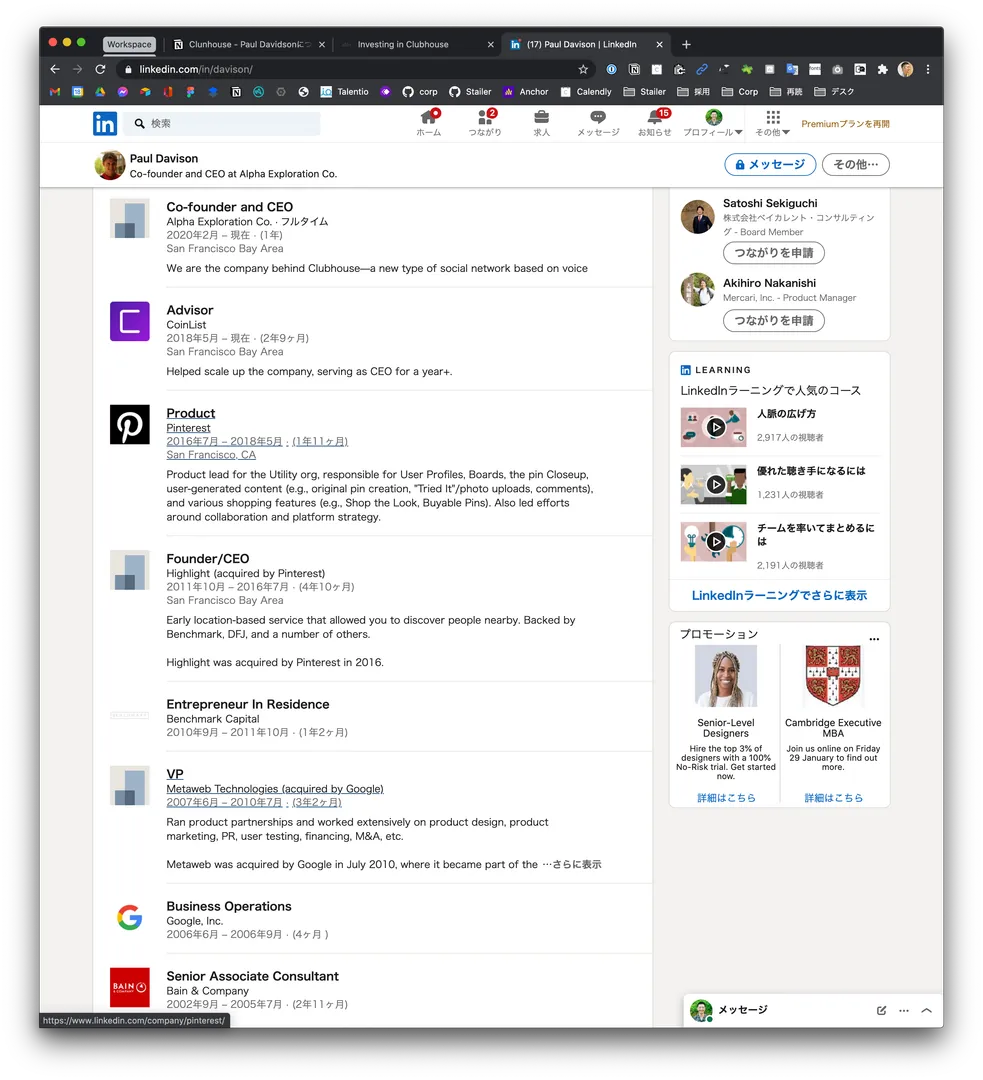
Career Summary
- 1998–2002: Stanford University
- 2002–2005: Bain & Company (strategy consulting, first job after graduation)
- 2005–2007: Returned to Stanford for MBA
- 2007–2010: Metaweb Technologies, VP role (exact title unclear)
- 2010–2011: Benchmark Capital, Entrepreneur in Residence (EIR) — exploring startup ideas while affiliated with a VC
- 2011–2016: Founded Highlight
- 2016–2018: Pinterest, product management
- 2018–2020: Advisor at CoinList; co-developed Talkshow with future co-founder Rohan Seth
- February 2020: Founded Alpha Exploration Co.; launched Clubhouse two months later
Career trajectory: Stanford → Bain → Stanford MBA → (Google intern) → Benchmark EIR → Highlight → Pinterest acquisition → Talkshow → Alpha Exploration → Talkshow shuttered → Clubhouse
Lead Investor a16z — Andrew Chen's Blog
The following is a translation of Andrew Chen's investment announcement post:
When I first met Paul Davison, it took about 10 seconds to realize he was one of the most charismatic and energetic founders I'd encountered in a long time. He told me about a new startup he was building — one he had launched within the startup community and had big plans to grow. I'm not talking about Clubhouse. I'm talking about Highlight, a company Paul started in 2012. Highlight was exploring ways to connect people who were physically nearby — so you could say hello to a friend at the same museum or party. That company was ultimately acquired by Pinterest, and Paul spent his time there diving deep into social products through the lens of visual curation.
Last year, Paul reached back out to say he was working on something new. By then he had teamed up with co-founder and friend Rohan Seth — a serial entrepreneur who had spent years working on Android and Maps at Google, and a genuine technical genius. Together they were launching a new product using audio to connect people. Still not Clubhouse — this was called Talkshow, aimed at making podcasting easier by helping users find other speakers and streamlining the usual tooling.
You might notice a pattern. Paul has been working on social products for over a decade, iterating relentlessly, learning from each experiment, steadily building toward something that connects people in new creative ways.
After Talkshow, Paul and Rohan launched Clubhouse — an audio-first social app that makes it easy to talk with others. The product is structured around a series of user-created "rooms" where some people speak and others listen, and where participants can move fluidly between speaking and listening across a wide range of topics.
We were deeply excited from the moment we saw it. We're thrilled to announce that Andreessen Horowitz is investing in Clubhouse. We've had many people across the firm working closely with Paul, Rohan, and the team — from marketing and talent to editorial and culture leadership, including Chris Lyons from our Cultural Leadership Fund. We believe Clubhouse will be meaningful to the world by increasing empathy and offering new ways for people to talk with each other — at a moment when that's more needed than ever.
Clubhouse launched in early 2020. At first it was literally one room where the founders hung out. You could step in, have a great audio-only conversation with Rohan or Paul, and leave whenever you wanted. Like many new apps in Silicon Valley, it began with friends and family testing an alpha — but it grew quickly as Paul and Rohan shipped new features rapidly. Early users started inviting more people, and the community expanded to encompass a wide range of people and conversations. Groups organized around hobbies, culture, careers, and curiosity formed almost immediately. When I found myself spending dozens of hours a week in the app, it became clear something special was happening. Watching the community grow from hundreds of users to nearly two million weekly users was remarkable.
Clubhouse arrived at a difficult moment for social media — and it's reinventing the category in every sense, from how content is consumed to how people engage with each other, while empowering creators. In a world where social media typically demands hours of screen time, Clubhouse lets you listen while multitasking. You can tune in on a walk, while folding laundry, during a workout — like a podcast. Or you can make it the highlight of your evening, like a lecture or talk. But it's also interactive: if you have something to say, raise your hand and join the conversation. Instead of consuming highly edited static content, you're exchanging ideas in real time. It brings humanity and context to online social engagement in a way that feels genuinely fresh.
News Coverage at Launch
The following is a translation of a media report from around the time of Clubhouse's Series B:
The next killer smartphone app may already be here. I'm talking about Clubhouse, the audio-based social networking startup.
Clubhouse lets users drop in and out of temporary chat rooms, hosting everything from small "water cooler" conversations to large expert panel discussions. Since launching in March 2020, it's become a cultural phenomenon, attracting politicians, celebrities, and experts across many fields.
At the most recent weekly town hall, co-founder Paul Davison announced that weekly active users had doubled in recent weeks to two million. He also announced a new investment round led by Andreessen Horowitz, noting they now have over 180 investors.
While he didn't share specific numbers, The Information reported that Clubhouse is attracting interest at a $1 billion valuation — which would represent a 10x increase in value since a16z led the Series A in May 2020.
The platform's nature creates built-in monetization opportunities: event entry fees for large discussions, subscription-based clubs (like Twitch channels for Amazon), and perhaps unique animated emoji reactions for audiences. At the most recent town hall, the co-founder said they plan to test a creator monetization system — "tips, tickets, or subscriptions" — in the coming months.
Challenges remain. Like all social platforms, Clubhouse has faced criticism for offensive content. In September 2020, speakers were criticized for spreading anti-Semitic stereotypes. Twitter is testing its own audio chat room feature called Spaces.
But the most striking metric may be engagement. Since installing Clubhouse, I've personally spent more time in the app than any other social network on my phone. That's a remarkable signal for an audio-based product. I have little doubt that when Clubhouse opens to the public and releases Android, it could grow to tens of millions of users. The social media giants should be paying close attention.
Coverage of Highlight's Acquisition by Pinterest
Translation of an article about Davison's first company:
In spring 2012, an app called Highlight looked ready to break through. In 2009, Foursquare had captivated early adopters with location-based social networking. But where Foursquare focused on places, Highlight's founder Paul Davison focused on people. His app passively shared personal information with people nearby, with the hope of enabling all kinds of serendipitous interactions. The app never lived up to that promise, and Highlight has now officially come to an end: the company was acquired by Pinterest, and the app is shutting down.
Terms of the deal were not disclosed. However, Math Camp — the small team behind Highlight and other apps — is joining the visual search site. "The team behind Math Camp are experts in building innovative mobile products that help people with similar interests connect and discover everyday images and videos across platforms," Pinterest said in a statement.


![[翻訳] Why Founders Fail: The Product CEO Paradox](/_next/image?url=%2Fimages%2Fcovers%2F20210715.webp&w=3840&q=75)
![[翻訳] Why We Prefer Founding CEOs](/_next/image?url=%2Fimages%2Fcovers%2F20210720.webp&w=3840&q=75)


