10X's Most Important Value
10X has three values — the 10X Values — defined with the whole team as the operating system of our organization. Each value is an abstracted behavioral principle underlying a set of concrete habits, paired with specific "Do" examples.
Of the three, the one that feels most distinctively "10X" is "Work back from 10x." And this value comes with a Do: "fight with discontinuity."
So what does "something discontinuous" actually mean? I think it means something with all of the following properties:
- An issue that remains unsolved for some structural reason
- Something that requires gathering new facts through exploration and experimentation
- Something that demands a decision under uncertainty, not just a judgment based on existing knowledge
The Discontinuities We Took On in 2020
For 10X, 2020 was a year of taking on three major discontinuities — all of which required us to reject practices we'd previously believed in.
- From "full-office" to "with-remote" work
- From "full-scratch" to "with-partners" business
- From "full-stack individual" to "with-team" structure
1. From full-office to with-remote
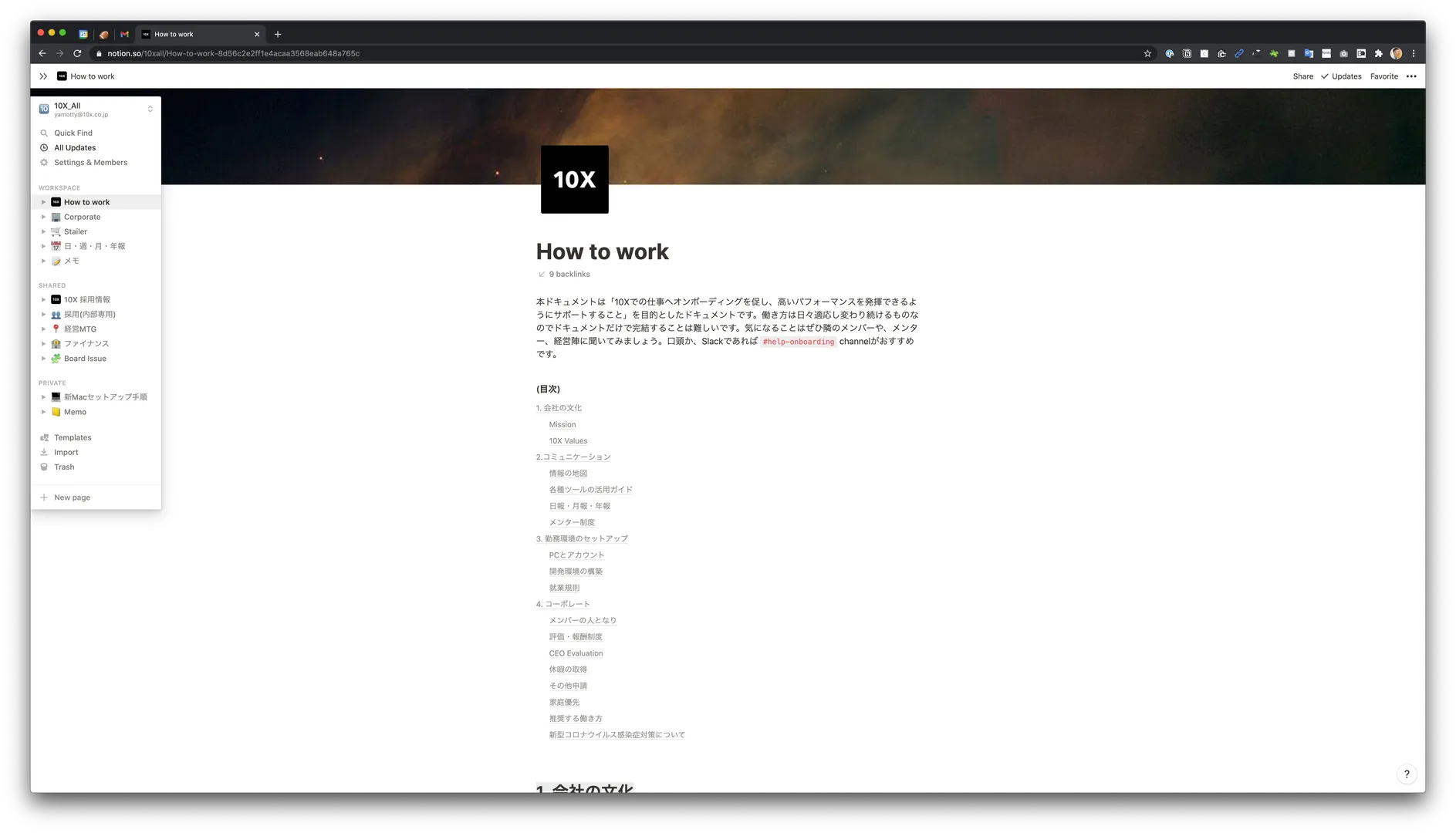
Since founding, 10X had operated with a culture of everyone working in the same place at the same time. Remote work was extremely rare. The reasoning was deliberate: to respond quickly to the uncertainty of early-stage business, we wanted face-to-face communication at low friction, even in the form of casual conversation.
Then COVID happened, and we had to rebuild from scratch.
We had to make remote work the baseline — which meant setting up online workspaces, creating self-onboarding guidelines, building systems that didn't depend on physical presence. We now designate one day per week as an office day for everyone, prioritizing internal peer communication, while leaving all other workdays open for each person to choose the environment that best suits their work.
The result: company and individual performance has actually improved. Being forced to confront the change uncovered a problem we'd never seen before — "always being able to chat means concentration is always at risk." By separating "focused remote days" from "discussion office days," we created space for both.
As a side effect, we were able to rapidly invest in building the infrastructure to support one of our core values: autonomy. Beyond the institutional output, the more valuable byproduct was this: we were forced to carefully articulate the company's philosophy in writing, weaving it through every policy and document. That work laid the foundation for non-linear organizational scaling.
2. From full-scratch to with-partners
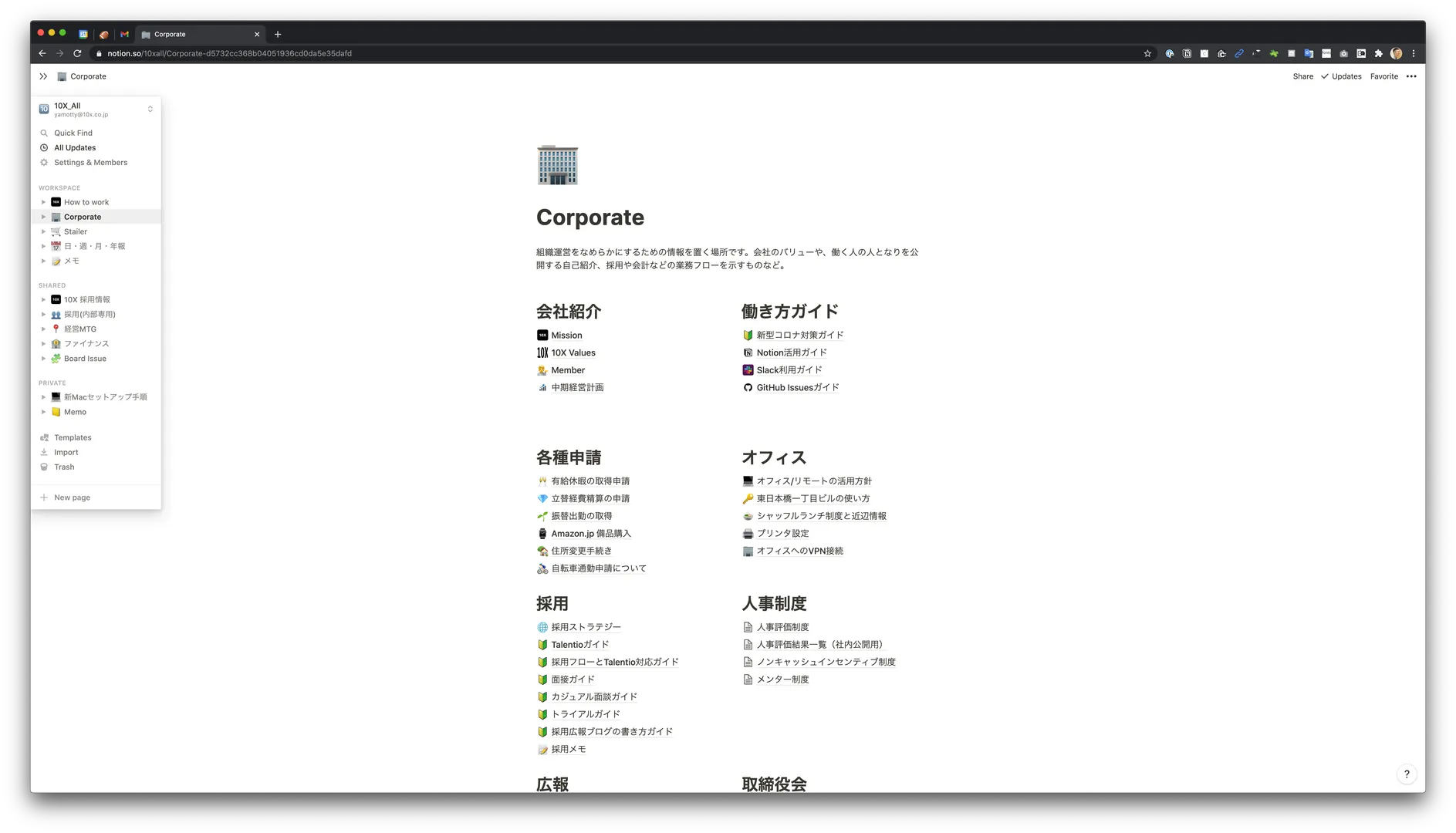
On the business side, we closed Tabery (our founding product) and used the insights we'd gained — from both consumers and retailers — to abstract upward and build a new product: Stailer.
This wasn't just a pivot from B2C to B2B2C in terms of customer type. There was a deeper discontinuity: we abandoned the idea of building everything ourselves and chose a co-creation model with partners. I'm convinced this was the decision that unlocked 10X's non-linear potential.
The issue we're solving hasn't changed since founding — removing the burden from people's daily food shopping. We've tried various approaches: building an ordering API for net supermarkets to connect Tabery's meal planning to purchasing, building our own logistics (Tabekuru). Each attempt revealed a new limit.
Retail is the final battlefield — it aggregates supply chains across markets, processing centers, and warehouses to deliver high volumes of fresh SKUs across multiple temperature categories, often spanning multiple regions. The operational complexity is exponential. Building all of that from scratch, with full ownership, is simply not achievable with any finite amount of time.
The better path: partner with retailers who already hold massive assets, and use 10X's strengths in software and deep customer focus to simplify that complexity. Create leverage that doesn't depend on individual heroics. Build a new channel with a genuinely new shopping experience. We steered hard in that direction.
This introduced a new kind of uncertainty — not being in full control — that we'd never had to manage before. Building the organizational competency to handle that uncertainty, being willing to transform ourselves before asking anyone else to, and retroactively making that big bet the right call — that's become my role.
3. From full-stack individuals to with-team structure
At 10X we share a premise: organization follows business. As the business model shifted, so did the organization.
We moved from a "everyone builds everything themselves" model to one where shared goals are clear, roles are explicit, and the job is to maximize throughput by collaborating with skilled neighbors. We now have a real team, not just a collection of generalists.
The CFO joined and strengthened the board. The team grew from 8 at the start of the year to 20+ including offers extended. We attracted people who genuinely expand the company's potential.
From a product-maker led mostly by software engineers, we now do fundraising as a team, business development as a team, partner success as a team, recruiting as a team, and PR as a team.
For me personally, this was the year of massive delegation. I had managed nearly every function myself — product, business, corporate. This year I handed almost all of it off. Honestly, I'd spent years anxious about whether I'd ever be able to delegate product and strategy decisions. But watching team members perform brilliantly inside the company's structure resolved that anxiety. The transition was smoother and bolder than I'd expected.
Delegation, I've come to understand, is fundamentally a team-first issue. You can only hand things off when there's a team capable of receiving. I now take real pride in building that team.
And as a founder, my role has crystallized: always find the most uncertain, longest-horizon, most discontinuous issue in the company; validate it; build a team around it; hand it off. Repeat. That's how I create unstoppable growth.
(Special thanks to Raksul COO Fukushima-san and many other senior founders who gave me counsel along the way.)
Toward 2021's Discontinuities
At the end of 2020, I shared a medium-term plan with the team. It had three parts:
- The retail experience 10X wants to build into the world
- The businesses 10X will create
- The organizational structure needed to support them
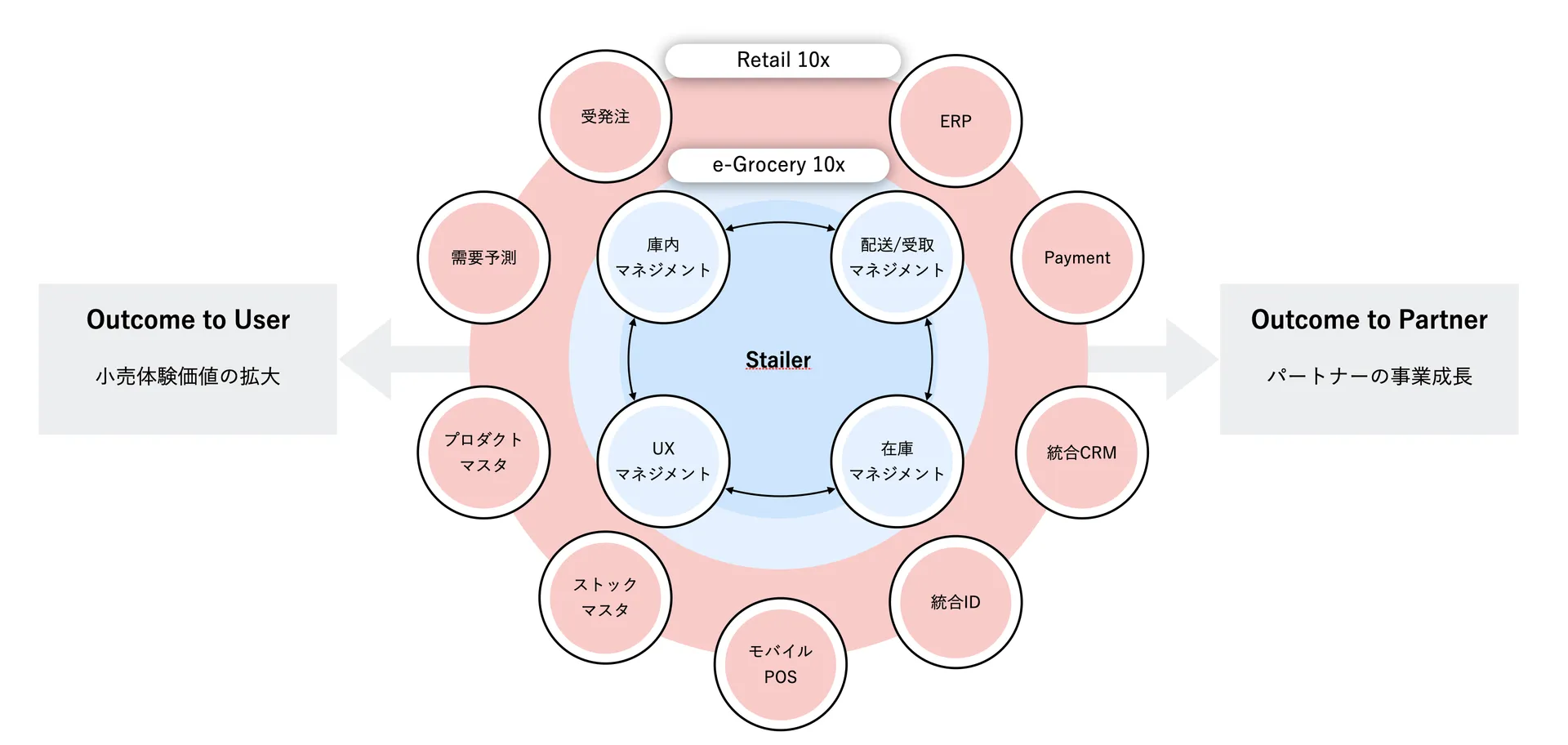
Working backward from there, my honest assessment is: today's 10X — its product, its business, its organization — is just the very first step.
Taking Stailer from a net supermarket UX layer to a full operating system for retail chains — that's the discontinuity 10X is taking on starting in 2021.
In 2020, because of limitations in my own development and the company's maturity, there were retailers we couldn't bring on board. That stings. My goal is to become someone — and build a company — that deserves the trust of traditional retailers, can stand across from them as an equal, and can meet their expectations head-on.
If there's a fourth property of "discontinuous things," it might be this: they come with the pain of not being able to see ahead. But the work of making folds in uncertainty, generating your own answers, and validating them — that work reliably delivers the joy of creation. And for me, the expression of creativity is the joy of being alive.
I want 10X to always be a place overflowing with opportunities for each person to maximize their creative potential. And I want to build a vessel capable of even greater discontinuity. To do that, we need more people who expand what the company can become. Here's to a big year ahead.