When someone asks me "What's the biggest challenge at Stailer?", my recent answer is: scalability.
How do we reduce the burden of individually intensive partnership work and instead produce higher-quality outputs as a repeatable pattern? I believe the direct answer lies in evolving Stailer into a platform.
Background: Platforms vs. Aggregators
Before the main argument, I want to ground us in a conceptual framework from a piece I found highly compelling: "The Bill Gates Line" by Ben Thompson (2018), cited in a Japanese blog post on how note could avoid becoming Facebook or Twitter.
The piece argues that not all of Big Tech's services are actually platforms. It introduces a contrast between "platforms" and "aggregators":
This is ultimately the most important distinction between platforms and aggregators: platforms are powerful because they facilitate a relationship between 3rd-party suppliers and end users; aggregators, on the other hand, intermediate and control it.
When Bill Gates famously pushed back on calling Facebook a platform, his punchline was:
"That's a crock of shit. This isn't a platform. A platform is when the economic value of everybody that uses it, exceeds the value of the company that creates it. Then it's a platform."
So What Does This Mean in Practice?
Borrowing again from the Japanese blog post on note:
Both platforms and aggregators provide value to third-party suppliers. But aggregators generally capture suppliers by offering efficient access to consumers — their first move is almost always to obsessively fulfill consumer needs. Facebook did it through social connection, Google through search and knowledge, Apple through the iPhone and digital life.
In other words, the question is: who sits in the driver's seat of the user experience?
- An aggregator directly locks users into its own service, using that stickiness to gain leverage over suppliers and directly control the user experience
- A platform focuses on providing tools that let third parties control the user experience, staying involved indirectly
Is Stailer a Platform?
Stailer is described as a platform — and we do describe it that way. But why exactly Stailer is a platform has never been explicitly defined. Let me try to define it clearly using the framework above.
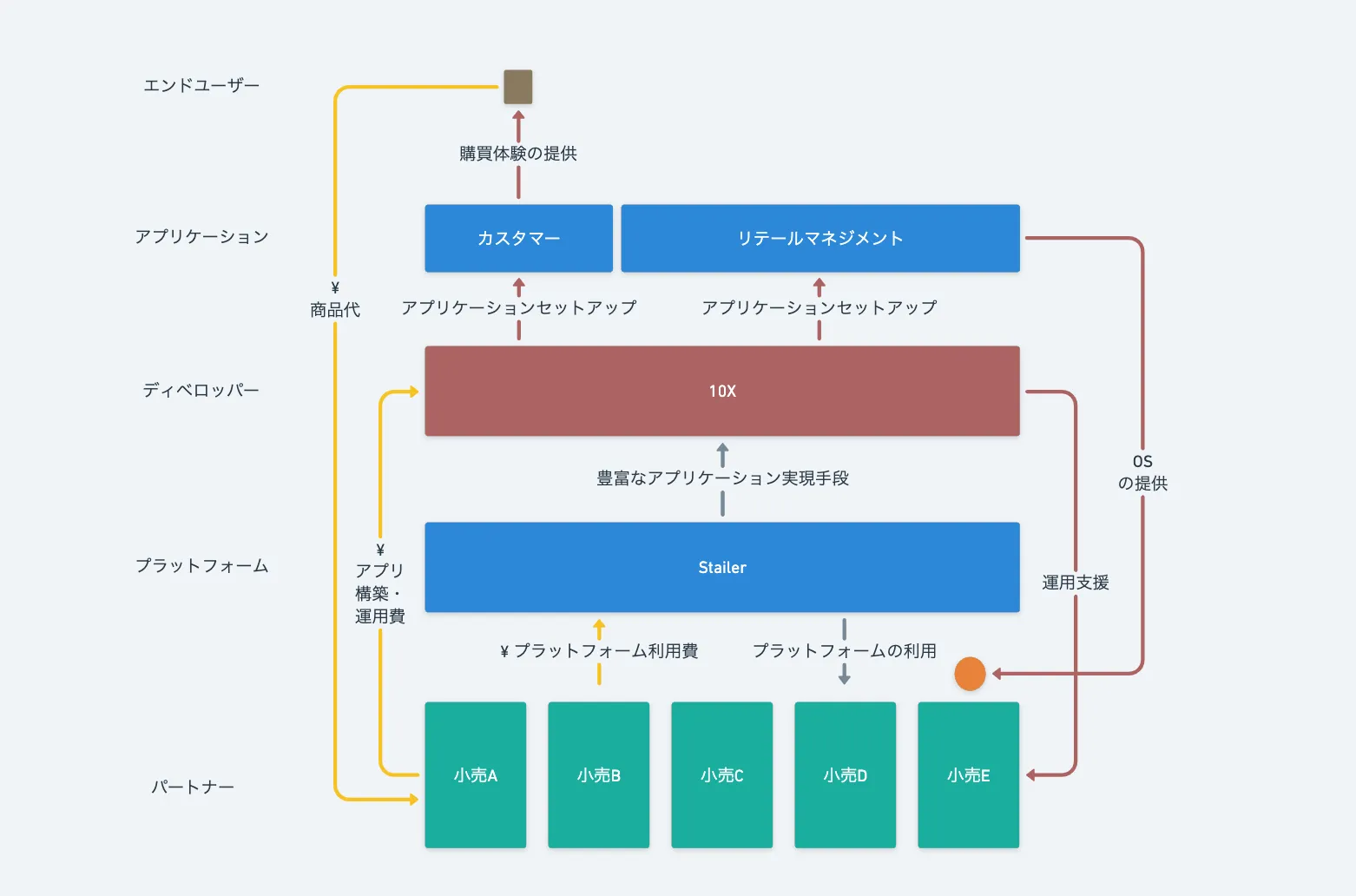
Why Stailer is a Platform
Defining Stailer as a platform also makes certain things clear by implication:
- Stailer is not a platform from the perspective of end users (net supermarket shoppers) — it appears to them as an application
- Stailer is not a platform from the perspective of store operations staff, drivers, or corporate employees hired by suppliers — it appears to them as an application too
- Stailer does not directly control the user experience. The entities that control user experience are Developers and retailers (partners).
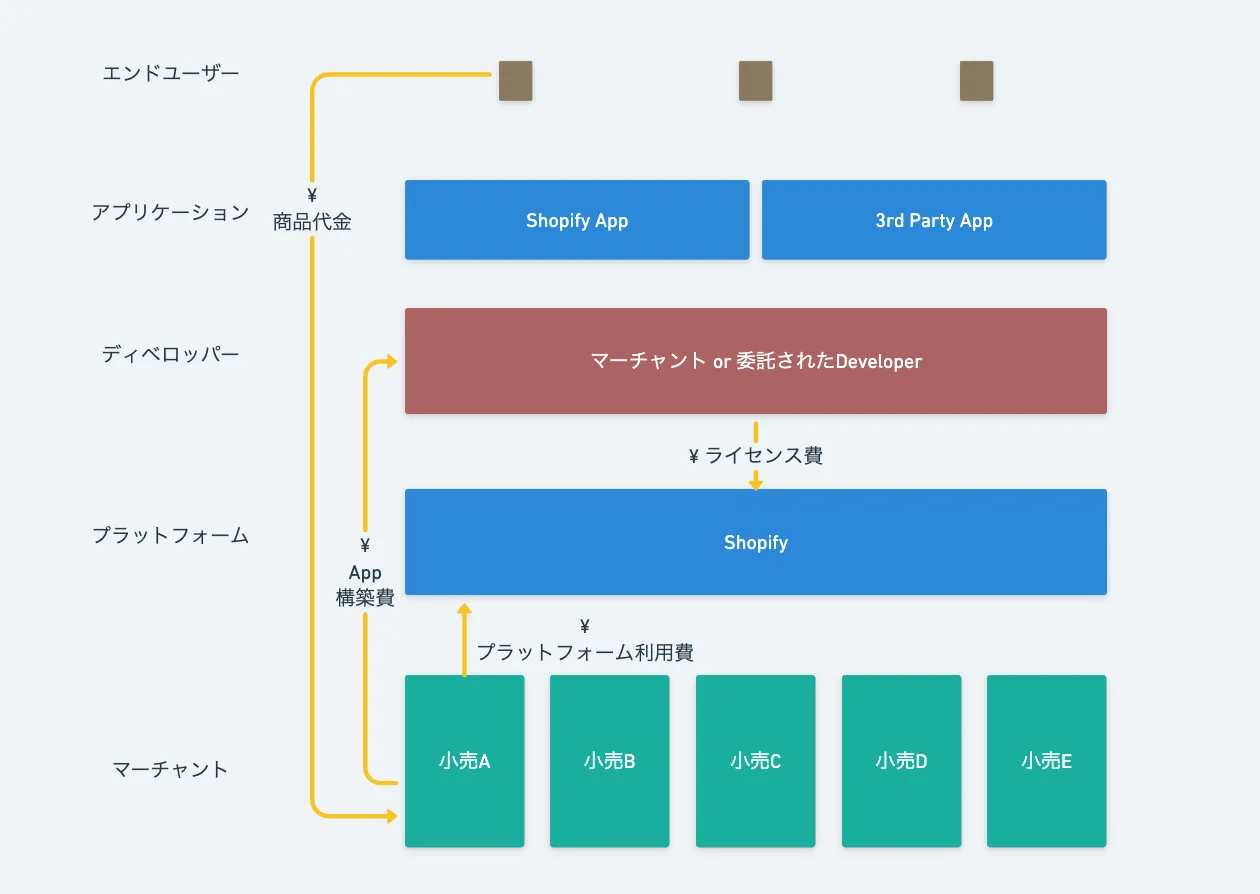
The same logic applies to Shopify. Shopify itself doesn't control the user experience. It provides the platform on top of which countless applications are built. Those applications are then used by merchants — or developers working on behalf of merchants — to shape the actual experience for shoppers.
Aside: What If Stailer Became an Aggregator?
Instacart in the US, or Amazon's marketplace partnerships with retailers like Life, Seijo Ishii, and Valor in Japan (where Amazon aggregates third-party grocery retailers), are classic examples of the aggregation model.
The aggregator bundles "customers who want delivery," "operators," and "the brands selling on the platform" into a triangle of matchmaking. Users say they're shopping "on Instacart (at Safeway)" or "on Amazon (at Valor)" — not "at Safeway" or "at Valor." The same logic applies to Quick Commerce through Uber Eats, Wolt, and similar services.
If Stailer were to become an aggregator — say, by launching an Instacart-style aggregated marketplace across all its partners — it would create an explicit aggregation model. But that aggregation would clearly erode the platform's value, because it would introduce competitive pressure among Developers and retailers, potentially destroying their economic value.
This tension has already surfaced for Instacart: many supermarkets competing against each other on the Instacart marketplace are increasingly questioning whether to trust their own e-commerce infrastructure to the very platform that hosts their competition.
Aside 2: The Relationship Between Applications and Platforms
In the application vs. platform relationship, the parent is actually the application, not the platform. The platform only has meaning once the issue of "scaling applications that deliver real value" becomes large enough. Applications come first. Platforms are built to scale them. The tricky part for Stailer is that both the exploration of valuable applications and the scaling of them are simultaneously critical right now.
Where Is Stailer Going as a Platform?
Stailer needs to focus on two platform roles:
- Exploring and defining what "valuable applications" look like
- Building a platform that allows third parties to reliably and easily deliver those applications
Beyond just platform development, continually exploring the right applications is necessary — because the playbook for succeeding in online grocery hasn't been fully figured out yet.
Value exploration and scaling. When both are required simultaneously, the relationship between Stailer and its stakeholders might look like this:
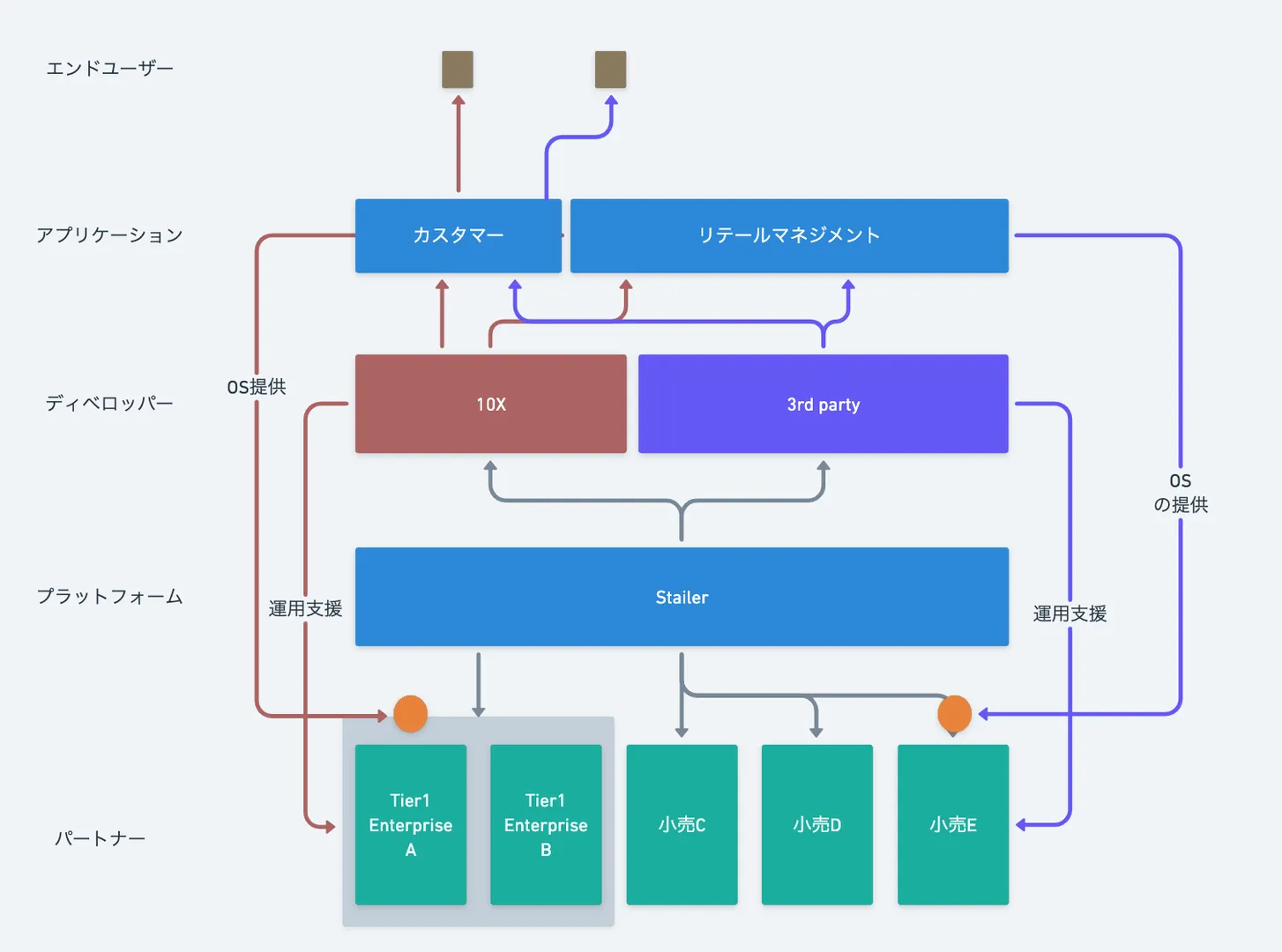
- For a small number of partners, 10X itself continues to act as a Developer, directly shaping the customer and staff experience
- Through those partner-facing and customer-facing engagements, we continually explore "valuable applications" — particularly with high-tier enterprise partners where the stakes are highest
- At the same time, we build a platform open enough for many partners and Developers to use Stailer at scale
Every Stailer activity going forward should align with either (1) application exploration or (2) platform expansion.
Recognizing the Gap, Stepping Toward the Future
Finally, let me be clear about the gap between what Stailer should be (To Be) and where it is today (As Is) — and look ahead to what that means.
One concrete example of the journey:
- Step 1: Deliver "New Feature A" to Partner A. High value confirmed.
- Step 2: Build that feature into the platform so Developers can add it freely to any application
- Step 3: Partners B and C can now request Developers to set it up for them
The Issues Ahead
Right now, honestly, Stailer's implementation and organization don't fully reflect the clean separation between application and platform. But I believe the biggest issue is exactly this: properly decomposing Stailer's implementation to match that target architecture, and designing the organization to match. For example:
- An architecture where platform and applications are separated at the code and data level and can be operated independently
- Clear, documented rules for how third parties use Stailer, with an environment where applications can be set up and operated within appropriate constraints
- Maintaining reliable quality and security standards (SLA/SLO/SLI) even when mediated through third parties
Stailer's current staff app, inventory management system, and customer-facing app are all well-regarded by users. Building these from scratch would take enormous knowledge and resources for any third party. Stailer functioning as a platform means the speed at which Stailer's value reaches the world — through many Developers — accelerates. And that acceleration is ultimately the fastest path toward the goal of Online Penetration.
Steps
Getting there won't happen overnight. Here's roughly how I envision the progression:
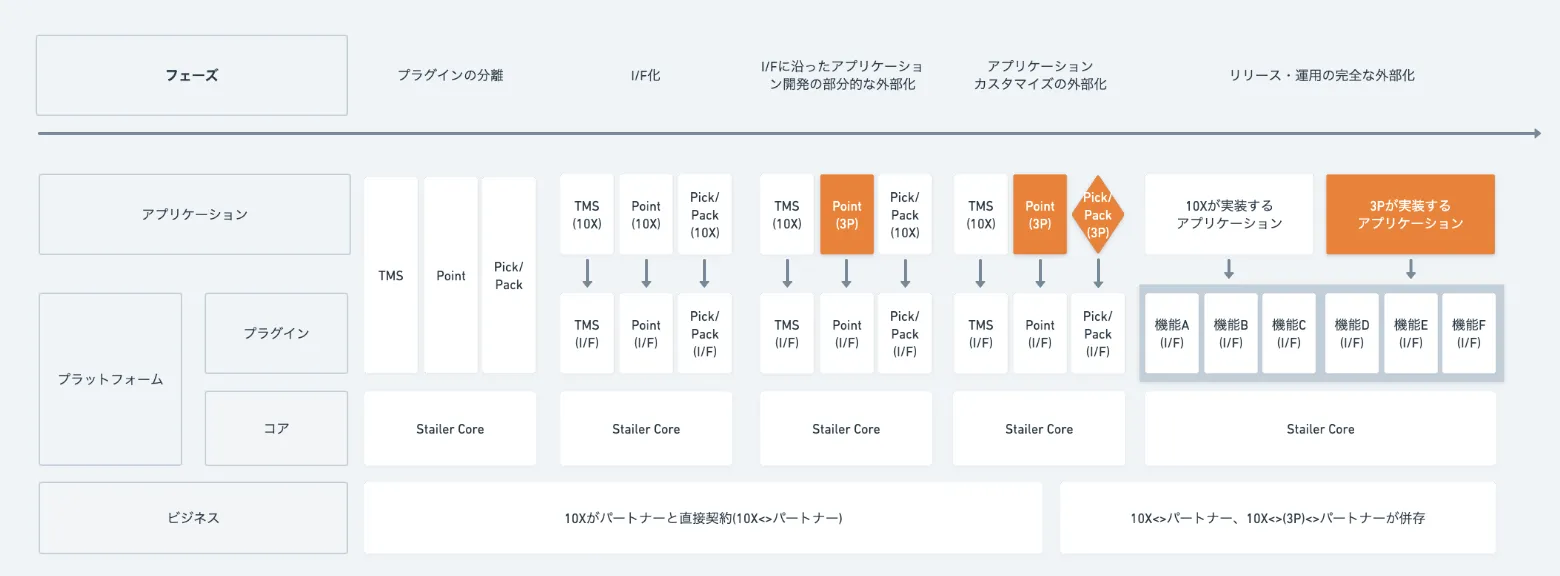
I've laid out the blueprint for Stailer as a platform here — but there are many real hurdles ahead, and it's a significant challenge for 10X. We're going to go do it.
Next time, I'll write about what features Stailer should actually build, now that the platform direction is clearer — getting into the layer closer to actual user experience.