In the previous post, I wrote about how 10X thinks through the product feature roadmap and what specific roadmap we're envisioning for driving the business forward. Take a read if you haven't already.
This follow-up covers the other side: how we feed inputs into the Stailer application roadmap company-wide, how we integrate those inputs, how governance is structured, how decisions get made, and how development actually flows.
Why share all this publicly? Because I want to build this roadmap forward with you. I want to build the best product team possible. And to get there, I first need people to be interested — so I'm putting pen to paper.
Background: Separating Application and Platform
In Stailer's current system, there isn't a strict architectural separation between "application" and "platform," and we're in the process of making that distinction clearer. My thoughts on this are covered in an earlier post.
As described there, Stailer's goal is the state of "fully externalized release and operations" shown in the figure below. Right now, we're working hard to move left to right across that diagram.
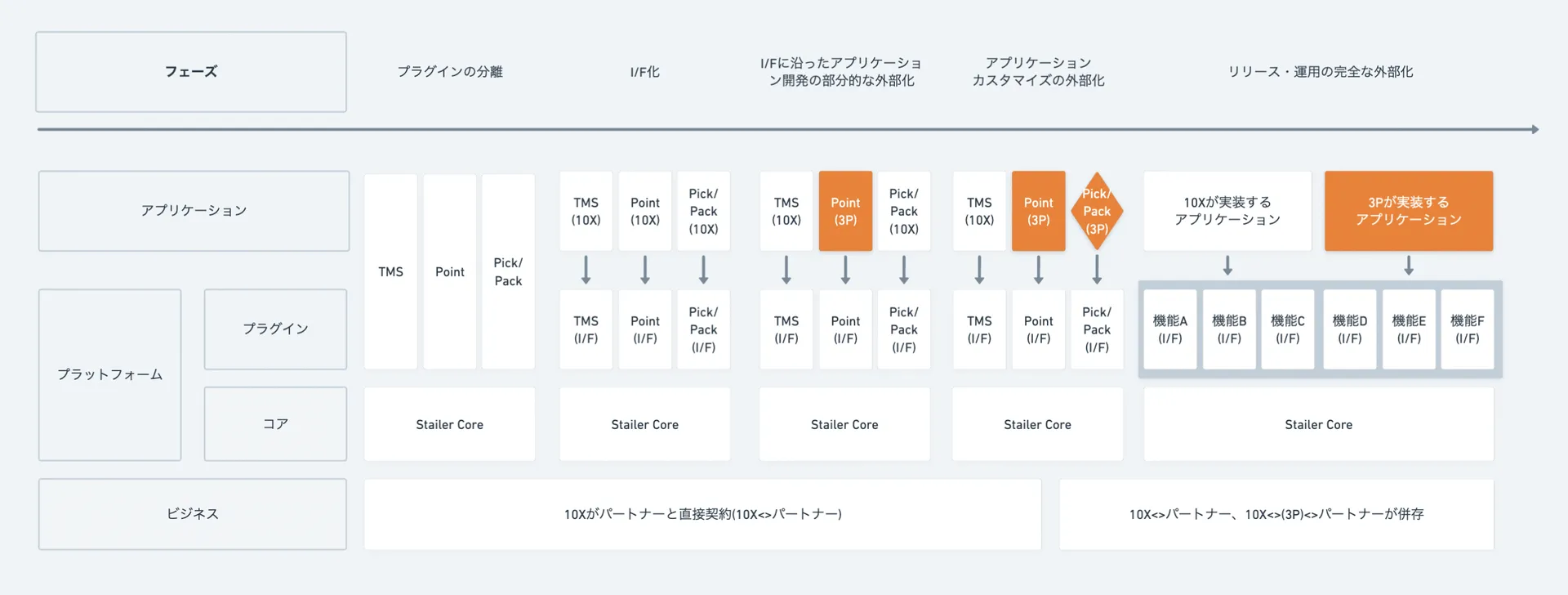
In short, what we're aiming for is:
- Platform: Each feature's interface is separated and included as a plugin
- Application: The platform's plugins are used to build what's actually delivered to users
Scope of Development Under the Roadmap
"Application development" carried out through this roadmap is aimed at the following outcomes:
[Scope of roadmap development]
This is closely modeled on Bezos's 7 rules — I've drawn heavily from them.
Aligning Expectations with Stakeholders
The goal is to appropriately align expectations with the three stakeholder groups involved in Stailer application development.
Inputs to the Roadmap
Inputs for Adding Items
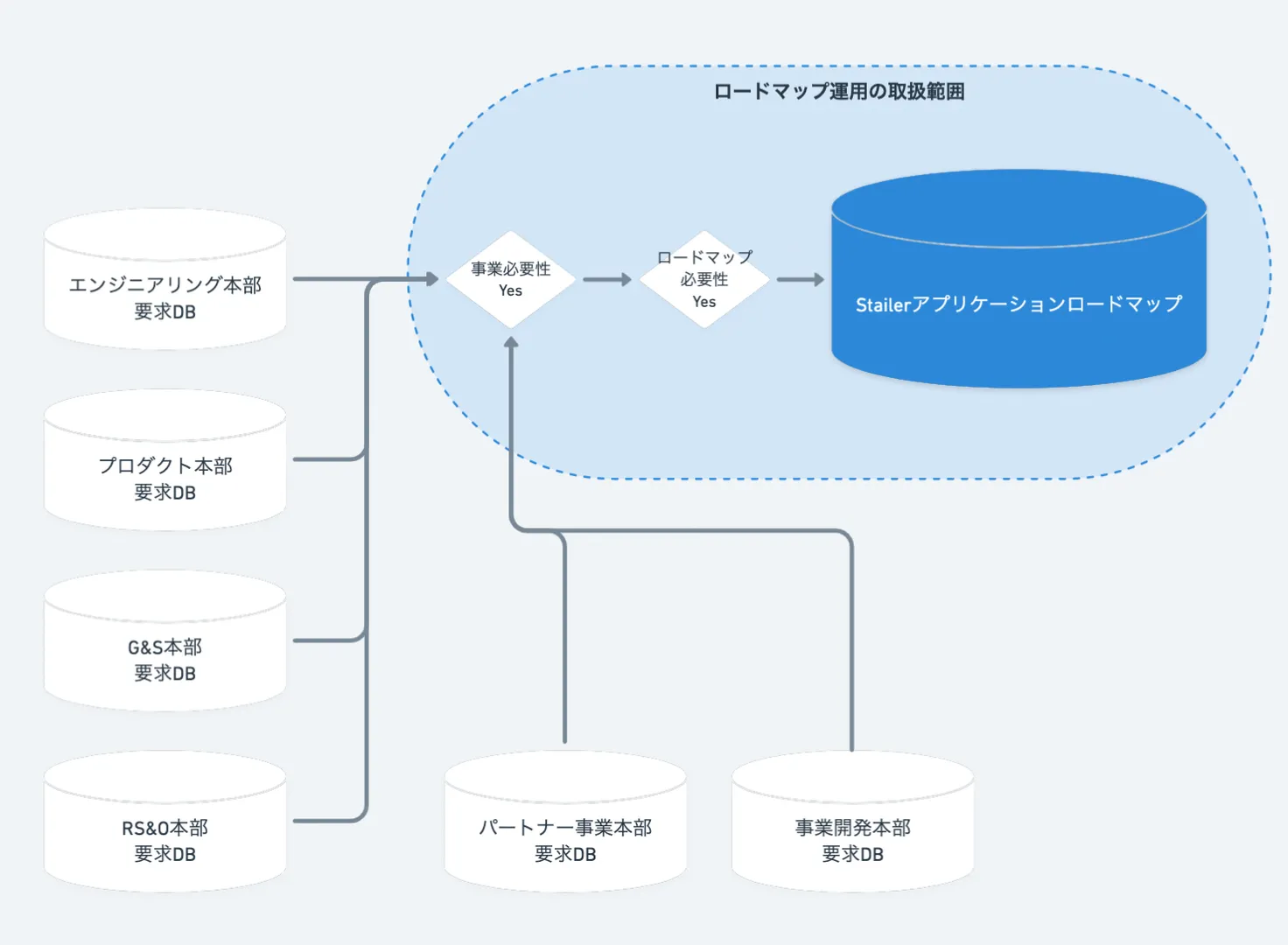
New demands against Roadmap v1 are expected to arise continuously:
- New partners requesting specific features as a condition of onboarding
- Existing partners requesting features needed for their business growth
- 10X's own growth strategy and feature requests aimed at improving the customer experience
For each of these, the relevant business unit will manage requests in a database under appropriate governance (see image for reference), and a mechanism will be built so those requests can be evaluated for inclusion in the Stailer application roadmap.
Inputs for Prioritization
Items on the roadmap are assigned "meta-information that enables prioritization." Specifically, the following information is added to each item as input for decision-making:
- Flywheel relevance
- Expected business impact
- Estimated impact on 10X's business value
- The requesting partner and their context
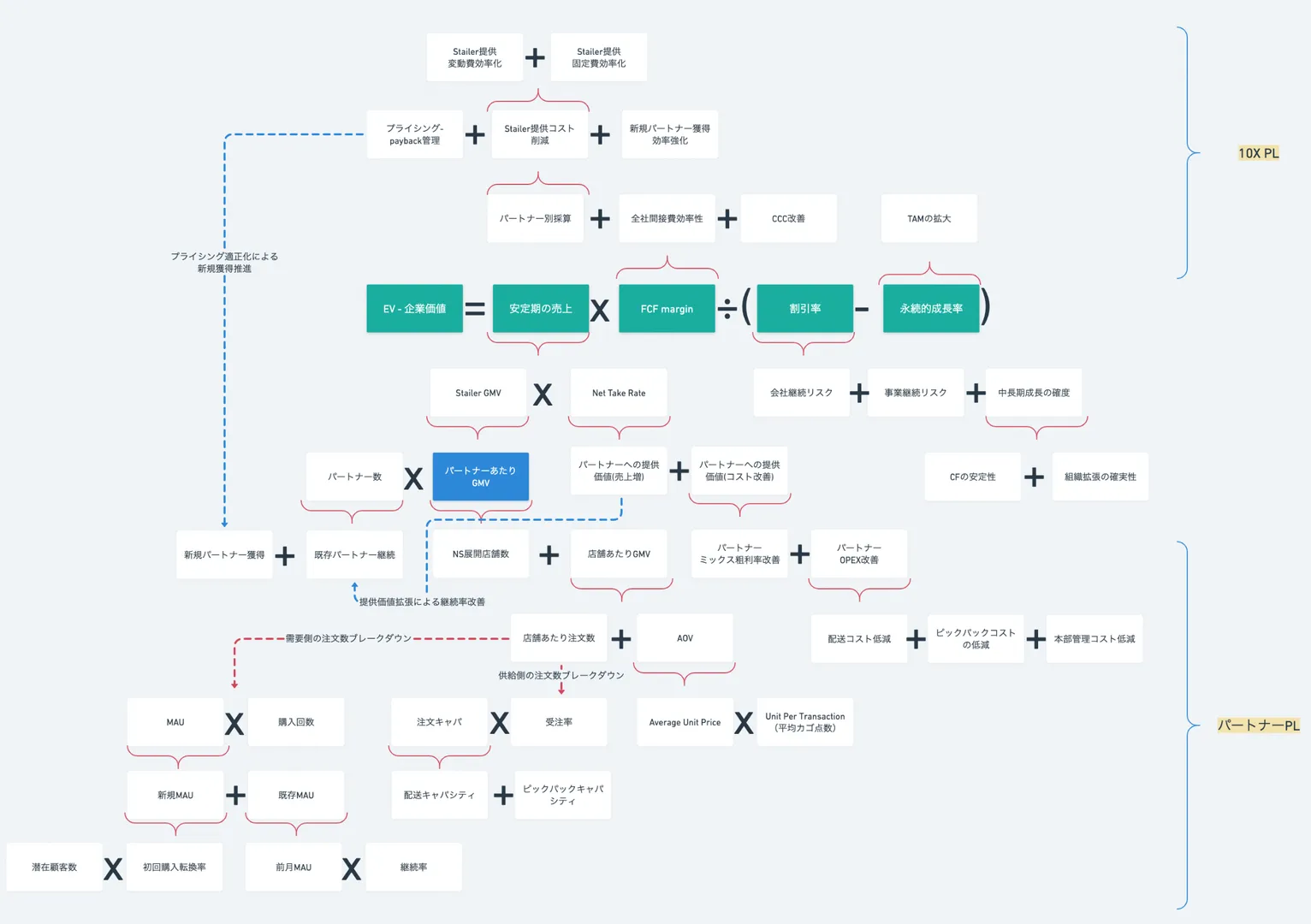
For item two specifically — business value linkage — we're working with the Corporate Strategy team to map the company's value drivers, and relating each feature to that map. The CFO created the diagram below in a single evening (Gebanniか — a reference to the manga character who produces absurd amounts of work instantaneously):
Inputs for Assigning Development Ownership
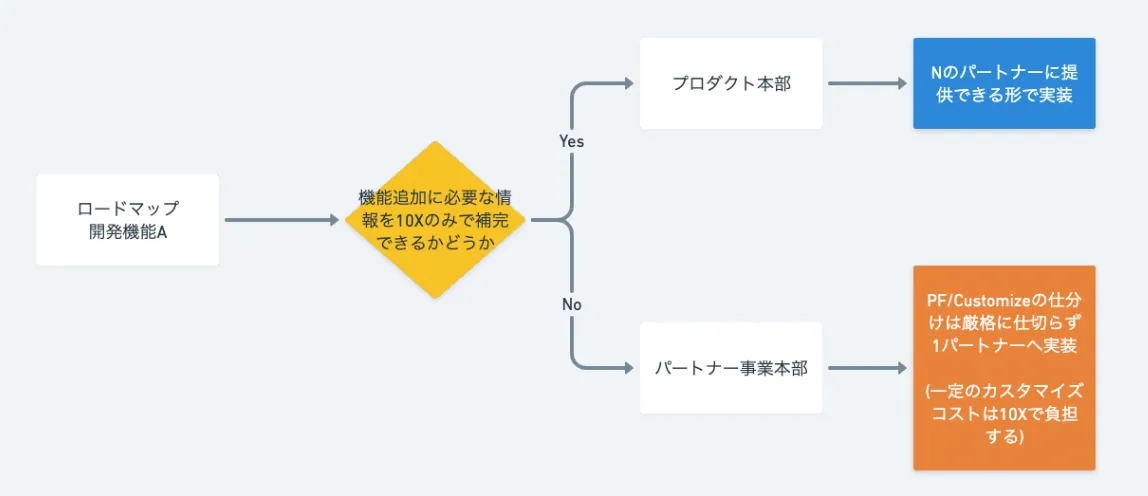
10X operates as a matrix organization: a Function Division that builds assets, and a Business Division that leverages those assets and drives the business with customers. Roadmap development can fall under either division. To determine which, we evaluate "whether the information needed to implement a feature can be gathered by 10X alone, without requiring deep dives with a specific partner." (See the flowchart below.)
Roadmap Decision Flow
Decisions on the roadmap follow four broad steps. The overall flow is as follows — we'll be kicking off full operations in September 2022:
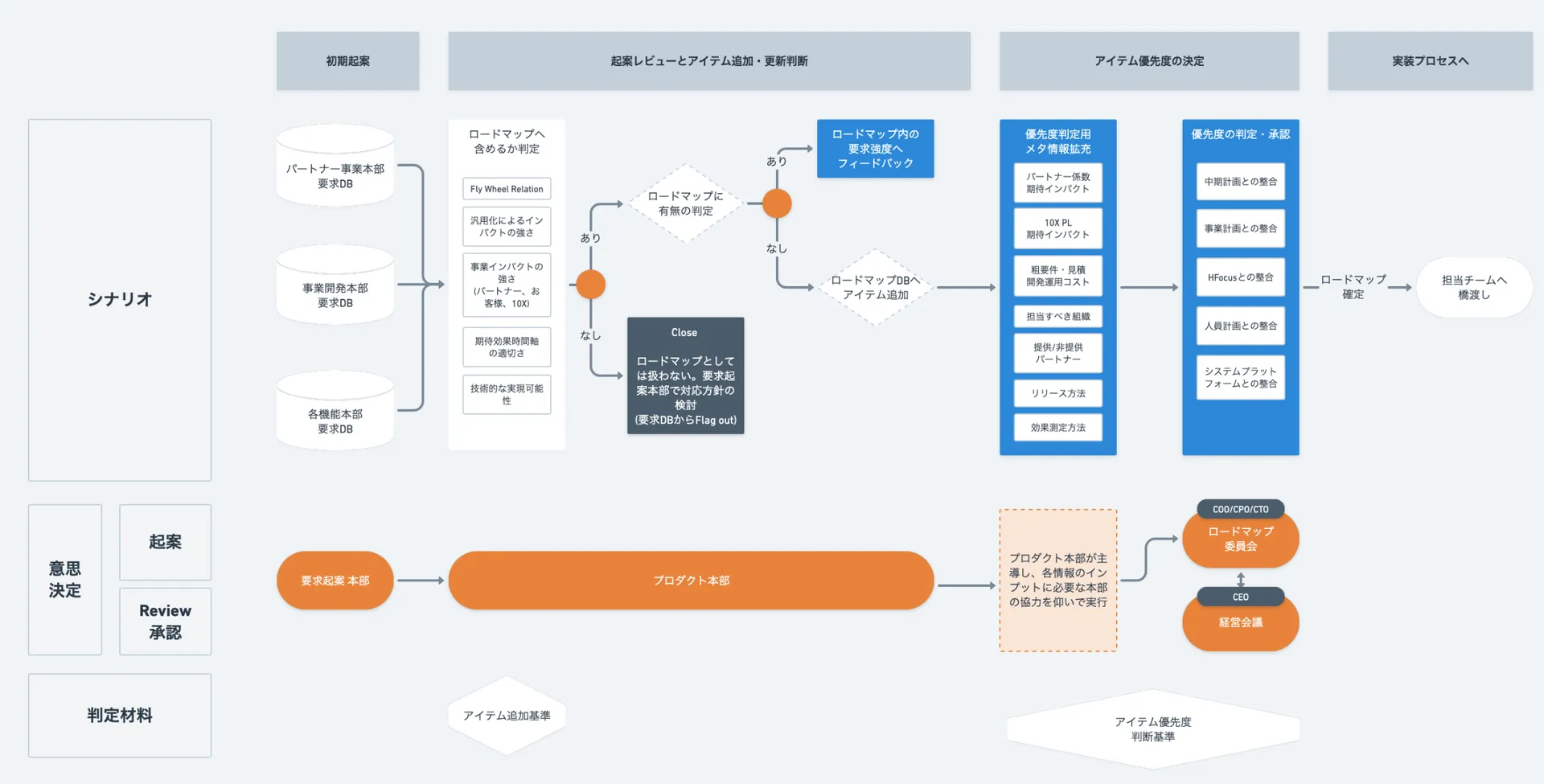
Decision Criteria
For item addition and prioritization, we'll build up examples and refine the decision criteria over time:
- Item addition criteria: An item is added to the roadmap only when all criteria are "Yes"
- Prioritization criteria: After filling in all criteria, priority is determined holistically based on ROI for "business value and user experience"
What Product Management Does
I've just walked through how the Stailer application roadmap is operated. In parallel, we've also reset the PM team's mission at 10X, so let me briefly touch on that:
Maximize business value (10X gross profit) and customer value (ToC & ToE business and experience value) through the design, realization, and delivery of the Stailer application (feature) roadmap
That is: the PM team's job is to move this roadmap forward. That's the declaration.
10X's product is continuously expanding thanks to an exceptional team, and PMs are responsible for controlling the return on that investment. If you're drawn to product management where you work with diverse colleagues, drive substantial products, and stay accountable for outcomes — we'd love to hear from you.
And for my part, I intend to make this company a world-class product company (this part is important). If you have the ambition to be one of the people making that happen on both sides of the equation, I'm exploring opening a CPO role. Nothing confirmed yet, but if you'd want to have that conversation, I'm ready when you are.