If I were to define Japan's single most critical issue, my answer would be:
Through mitigation measures against the rapid population decline and demographic shift (aging), create a society that leaves hope for the current generation of children — and two generations beyond — to live as Japanese citizens.
This issue is framed with a target horizon of approximately 2100.
Background
Most of the background data is well-summarized in publicly available materials, much of which is already known to Japanese citizens. As the most reliable reference, I'm linking the following materials published by the Ministry of Finance (MOF).
(MOF reference links)
I prefer the MOF materials over those from the Ministry of Health, Labour and Welfare or the National Institute of Population and Social Security Research (NIPSSR) because I believe the MOF is constructing its materials with greater objectivity, partly to provide a critical counterweight to those other agencies. (This framing is borrowed from a friend, Hikaru.)
The Full Picture of the Challenge
The issue I've defined requires solving an extremely wide range of problems. I'll try to map out my understanding of this challenge as simply as I can.
Note: I'm deliberately simplifying, which means many elements have been stripped out.
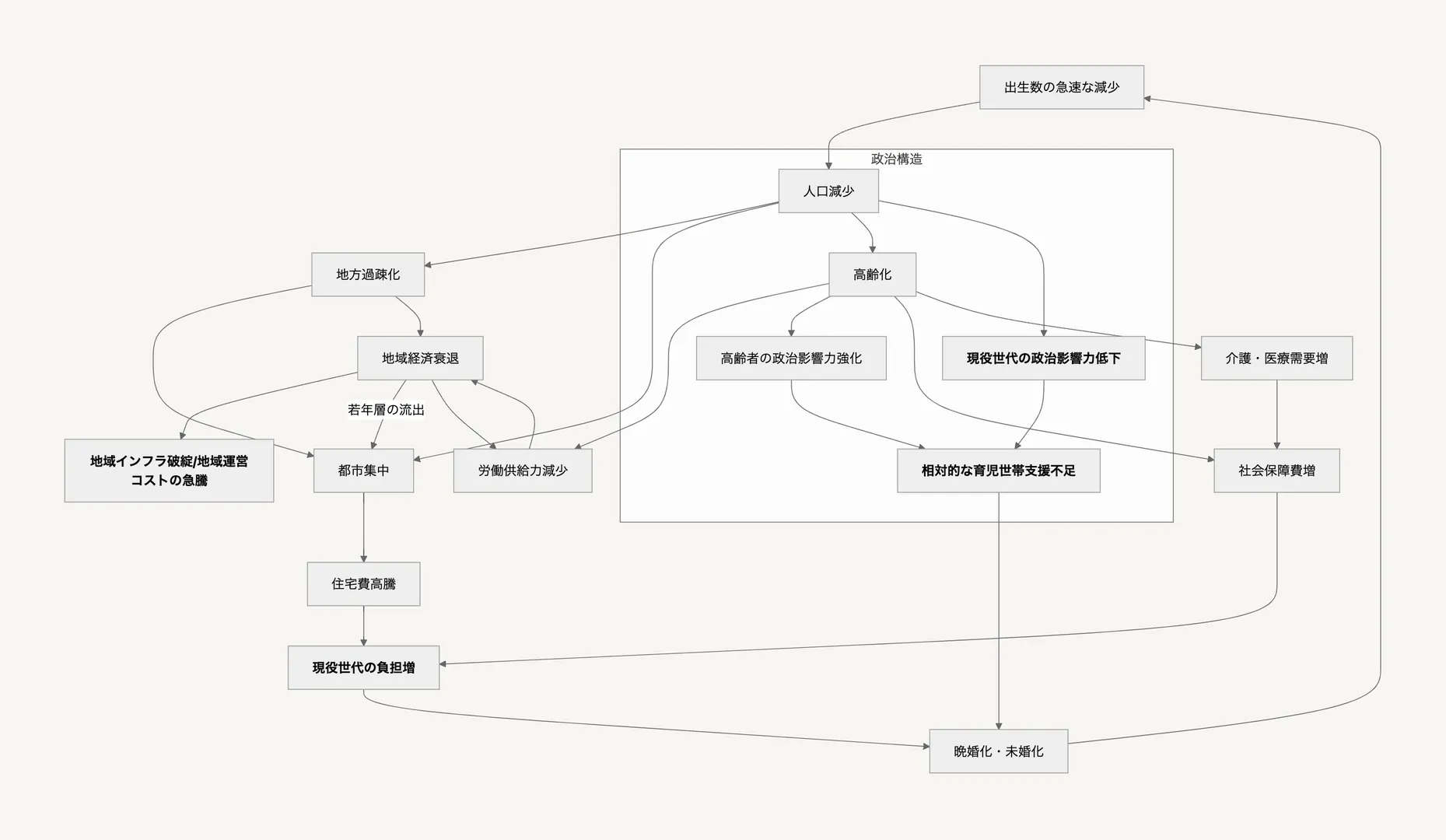
Identifying the Root
Assuming the above structure has some validity, what are the root causes at the very bottom of the problem tree? These would be the center pins to target when working on the issue I've defined. Narrowing to my own view, here are three:
Decline in Political Influence of the Working-Age Population
→ Reform the political and electoral system so the voices of working-age people — especially those raising children — are much more strongly reflected
Insufficient Support for Child-Raising Households (Relative to Others)
→ Create a decisive, bold child-raising support system focused on economic support to stop the decline in birth rates
Collapse of Regional Infrastructure / Surging Cost of Operating Rural Areas
→ Compact city strategies that consolidate increasingly sparse populations, rather than trying to maintain existing infrastructure in depopulating regions (which leads to inefficient social welfare and tax investment)
The Difficulty
Attempting to solve any of these will inevitably generate strong opposition and trade-offs. For example:
Strengthening Working-Age Political Influence
- "This is an undemocratic proposal that distorts one-person-one-vote"
- "This would unjustly restrict the rights of older people"
- "It would deepen generational divides further"
Bold Support for Child-Raising Households
- "This is fiscally unsustainable"
- "It's unfair to households without children"
- "Money alone won't solve the declining birth rate"
Compact City Strategies
- "This would force people to abandon land they've lived on for generations"
- "Local traditions and communities would be lost"
- "It would concentrate disaster risk"
Put simply, all of these trade-offs are generational ones.
The issue I've defined attempts to use indirect democracy — the "tool of problem-solving" — to close generational gaps. That's an extremely uphill battle by nature. And it sits poorly with the individualistic values that are increasingly seen as normative in today's world.
The challenges we face may require inventing new tools of problem-solving altogether. And I don't yet have that answer.
If I still have the energy, I want to live to see those tools developed — and to be part of creating the moment where society changes, painfully but really, in response to them.