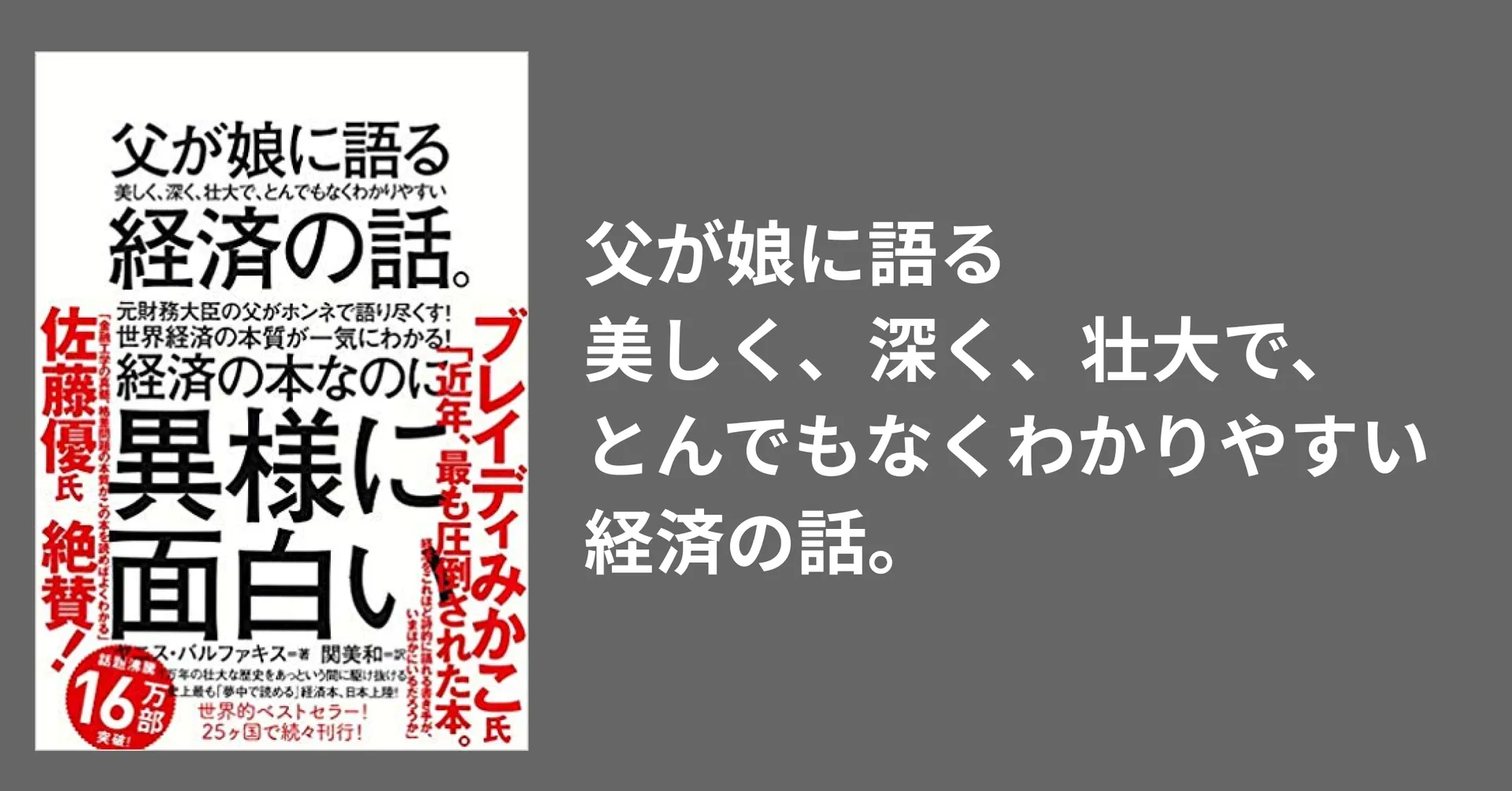
The author of this book is Yanis Varoufakis — the economist who served as Greece's Finance Minister during the Greek debt crisis, and now teaches at the University of Athens. He has a daughter living in Australia, from whom he was separated for years.
When his daughter was young, she asked him a question he couldn't answer satisfactorily — not for her, and not for himself:
"Why do some people have so much and others so little?"
He wrote this book to give her a real answer — to explain economics clearly enough that she could talk about it in her own words. (Note: this book is known in English as "Talking to My Daughter About the Economy: A Brief History of Capitalism.")
The core argument
The book makes two connected points.
First: it traces the structural and historical roots of inequality back to the origins of economic life itself. Inequality didn't come from some people being smarter or harder-working. It came from geography, accident, and the accumulation of power that followed.
Second: Varoufakis speaks from direct experience — someone who watched the Greek crisis unfold from the inside — about what it would actually take to reduce inequality. His answer is democratization: opening up the machinery of the economy to everyone, rather than letting it be controlled by a small number of powerful actors.
The world he sees is a collision between two forces:
- Commodification: a few powerful actors own the machines, accumulate wealth, and the gap keeps widening
- Democratization: opening up technology and economic decision-making to everyone, using democratic processes to move toward a more equal society
Which direction we go is up to us — up to his daughter's generation and ours.
My reaction
What struck me most was that this book's central theme — inequality — is also the central theme of two other widely-read books: Sapiens by Yuval Noah Harari (a historian) and Guns, Germs, and Steel by Jared Diamond (a geographer). Three scholars from entirely different fields examining the same question.
They reach essentially the same conclusions:
- Inequality is not a product of human intelligence — it's a product of geography and historical circumstance
- Reducing inequality ultimately requires democratizing the economy
- Technology, as currently deployed, is making inequality worse, not better
That third point is what I find hardest to sit with.
I started a company because I believe technology should improve the lives of ordinary people. But if these three serious thinkers are right, then building technology products alone isn't enough — and might, in aggregate, be making things worse.
The indictment isn't that any individual company is evil. It's that economic ignorance and disengagement from politics is what creates and sustains inequality. We've been complicit in it by not paying attention.
I came away from this book feeling that I need to understand economics better — and to be able to talk about how the economy should work in my own words. That's the standard Varoufakis sets for his daughter.
(Note: Hans Rosling's Factfulness argues that global poverty has genuinely improved. That's true. But the inequality Harari, Diamond, and Varoufakis are describing is not the gap between the very poorest and everyone else — it's the gap between the extremely wealthy minority and everyone else. Both can be true at the same time.)
The following is my summary of the book's main arguments. It follows the broad arc of the book but may not capture every nuance with perfect accuracy.
The origins of economics: surplus
Varoufakis's daughter grew up in Sydney and learned about the Aboriginal Australians — a people who were brutally displaced by British colonizers and remain impoverished today. Why was it the British who invaded Australia and not the other way around? Were they simply smarter?
No.
Economics began with surplus. Farming techniques developed where nature was harsh — people needed to produce more than they consumed to survive. Farming created surplus for the first time.
Surplus required record-keeping → language and numbers were invented. Surplus needed to be managed → the concept of the state emerged. The state needed defending → armies formed.
Surplus created hierarchy. And the social surplus generated by farming was captured by ruling classes, creating the need for an intermediary institution to redistribute — that institution was religion.
The Aboriginal Australians, living in rich natural environments, didn't need surplus in the same way. What did they develop instead? Art.
A people who didn't need surplus versus a civilization that aggressively managed it — when they met, the outcome is what history records. The difference wasn't intelligence. It was the environment they were born into.
The birth of markets: exchange value vs. experience value
There are two kinds of value in the world: exchange value (a price can be put on it) and experience value (the value of a shared moment, a view, a feeling).
These two types don't mix. In ancient Athens, experience value was considered the higher form. But over the past 200 years, almost everything has been assigned an exchange value — including experiences, and now even genetic information.
This shift came from global trade. European shipbuilding advances created the possibility of transporting wool to India and exchanging it for spices. The merchants getting rich on spices annoyed the feudal lords who held land and political power. The lords' response — historically one of the most brutal economic reforms — was the Enclosures: forcing peasants off communal land, using that land to raise sheep, and pushing the dispossessed peasants into debt-servitude.
This was England's "labor market reform." The steam engine followed. Together, they produced "unimaginable wealth and unspeakable suffering" — the first great economic inequality.
Profit, debt, and the Industrial Revolution
The true fuel of the Industrial Revolution wasn't coal — it was debt.
Varoufakis calls debt "a contract with the devil." Christianity originally treated debt as shameful. But as exchange value spread and merchants gained power — particularly Protestant merchants — a cultural reversal occurred: debt became a holy thing, a tool of divine economic planning. The word "redemption," meaning loan repayment, shares its etymology with Christian salvation.
Competitive pressure made debt unavoidable: "to win the race, you have to borrow." The structure had been built.
Finance and the "black magic" of money creation
Banks discovered they could create money almost effortlessly.
In the 1920s, a bank that lent ¥500 million to a new business could slice that debt into small units and sell them to investors — creating profit with no risk. Varoufakis calls this "black magic."
But when many of those businesses fail? Depositors panic and rush to withdraw funds the bank doesn't have. The gears run backward. Financial crisis.
Who rescues a failing bank? The central bank. But what happens when trust in central banks themselves erodes?
Why labor and money markets don't obey simple rules
In a market for goods, lowering the price usually increases demand. Labor markets don't work this way.
When wages fall, some employers think: "Great, labor is cheap — let's hire more." Others think: "Wages are falling — recession is coming — we'd better freeze hiring." The outcome depends on collective psychology, not price.
The same applies to financial markets. Lower interest rates make borrowing cheaper, but don't automatically produce investment. Both markets are governed by human irrationality — emotion, mood, imperfect expectations. No wage or interest rate policy can fully control this.
Humans built machines to overcome their irrationality. But are we operating machines, or are we serving them?
The curse of the machine
Technology reduces costs — but so does it for everyone. When everyone automates, prices fall. Fierce price competition erodes margins, weakens companies, triggers bankruptcies, spreads financial crisis.
Varoufakis calls this "the curse of the machine."
The solution would be opening up the machines to everyone. But the people who own the powerful machines strongly resist this.
The birth of monetary economies
In a WWII concentration camp, Red Cross packages created a small internal economy among prisoners. Cigarettes became the common currency — they didn't rot, they could be stored, they could accumulate interest through lending. A complete monetary system emerged spontaneously.
When the war ended, cigarettes were smoked, debts were defaulted on, and the economy collapsed instantly.
The lesson: monetary economies rest on the belief that they will continue forever. Remove that belief, and the whole structure dissolves.
The Red Cross distributed those cigarettes from a position of complete political neutrality. In the modern economy, the institution playing that role is the central bank — but central banks are deeply entangled with politics. They are not neutral.
Cryptocurrency and its limits
After the 2008 financial crisis shattered trust in central banks, people wanted currency that didn't depend on them. In November 2008, a paper appeared online under the name Satoshi Nakamoto, describing a currency secured by algorithm rather than institution. Bitcoin was born.
But Varoufakis believes even cryptocurrency can't be fully separated from politics. The fatal flaw: the total supply is fixed. In a financial crisis, who manages the money supply? And how do you do it without political intervention?
We've tried pegging currency to a fixed asset before — the gold standard — and it produced financial crises that ultimately required state intervention to resolve. Decentralization alone isn't the answer.
The final conflict
The only way out of these problems is full democratization.
The world today is in the middle of a battle: "Democratize everything" vs. "Commodify everything."
Leaving economic policy to experts is insufficient. Citizens need to think actively about their own future, articulate their views on economics in their own words, and use democratic processes to push toward equality.
Technology too must be democratized rather than controlled by a small class of capital owners — but those owners are vigorously fighting back.
(GDPR and related regulations are, in Varoufakis's reading, one front in this battle.)
Xenos
The Greek word xenos means "stranger" — but also "kindness toward strangers."
Varoufakis named his daughter Xenia, from this word. His hope: that she will be kind to strangers, will want a better economy, and will make the right choices to move toward a less unequal future.