This article fills the gap between two products: the Tabery "online ordering feature" announced in May 2019, and "Stailer" announced in May 2020. What was 10X trying to accomplish in the year between them, and what did we actually do? I'll try to be as clear and concise as possible.
(Note: in this article, "10X" refers to the company; "10x" means ten times, or discontinuous change.)
How the Tabery ordering feature came to exist
Creating 10x experiences — delivering something non-linearly better for users — has been 10X's mission from day one. The first product we built to pursue that was Tabery, a meal planning app.
The online ordering feature we announced in May 2019 was a 10X-style invention — the kind that only becomes possible when you find a way to do something everyone else has written off as impossible.
The idea: let users seamlessly order the groceries needed for their meal plans directly from within the app. In words it sounds simple. There were similar ideas everywhere — even multiple patents. But nobody had actually built it, globally. (After our release, a few similar cases emerged internationally in late 2019. I'm proud we led.)
We started development around September 2018. It typically starts with me asking for something unreasonable, but our product team is astonishingly good at R&D. I describe the problem I want solved, the team says "that would be 10x!" — and three days later, engineer Sawada had built a rough working prototype. (I was astonished and thrilled.)
When nothing like what you're building exists in the world, implementation uncertainty is enormous. Being able to lay a path to "something that actually works" is a major capability, and that demo ended up being critical to our fundraise and business planning.
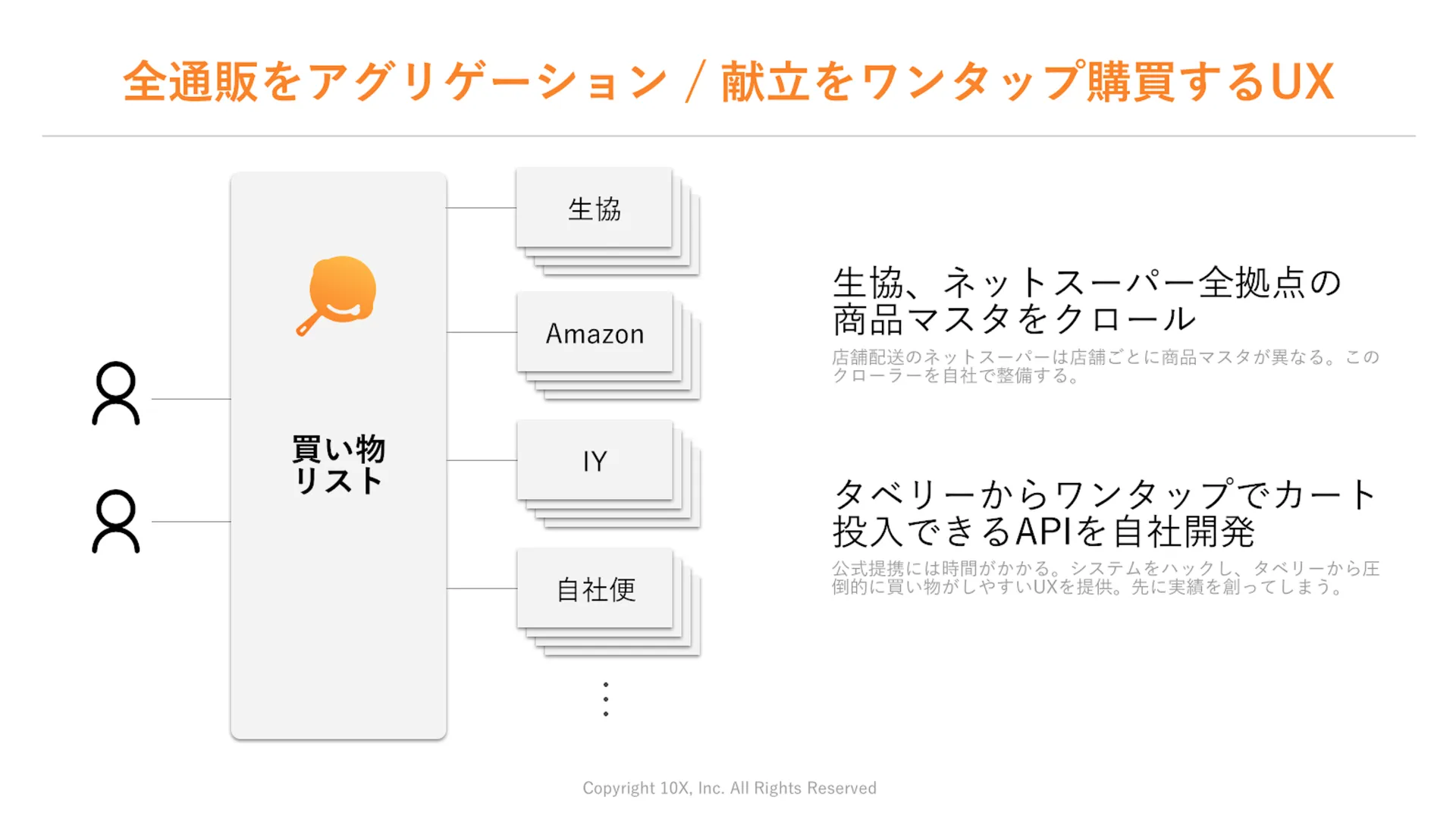
Japan has many food EC players — co-ops, net supermarkets — but no seamlessly integrated system like what we were building. Existing servers were built around physical stores and couldn't handle load or change; the databases were unwieldy; and most importantly, nobody had built architecture allowing API-level control over core EC actions like "add to cart" or "checkout." Almost no retailer had a dedicated digital team.
The original idea of letting users order food from meal plans had actually existed since our founding in 2017 — but at the time we'd tried the straightforward path: asking retailers for APIs. Records from July 2017 show meetings about this. They also note: "unlikely to be achievable in ten years."
If you can't get it from the outside, build it yourself. We made two major technical decisions: (1) build a system that continuously syncs product data from any online grocery into 10X's infrastructure, and (2) develop a site controller that handles the necessary interactions with each retailer's site.
In effect, we built an external DB and API layer for online supermarkets — without the retailers needing to do anything.
This is quintessentially 10X. Our software engineers solve technically hard challenges as if they were building an ordinary product. I'm deeply proud of them.
We also had to ensure nothing violated each retailer's terms of service or privacy policy — which required extensive legal R&D and painstaking implementation work.
The feature launched to user surprise and delight. Repeat usage among first-time users was higher than expected. Social media word-of-mouth spread. Of course there were plenty of hard challenges after launch, too — but those belong in internal documents.
"Would you build this for us?"
One to two weeks before the ordering feature launched, we reached out to the retailers whose sites we'd built integrations for — a precautionary check before going live.
In those meetings, we shared three things:
- We believe the future is online grocery. And the area most in need of change is net supermarkets. (Dream)
- We've built an external API and DB that can control existing online grocery systems. (Infrastructure)
- Using this, we've created a seamless customer experience in Tabery. (UX)
The first reaction after we finished was invariably confusion. Then rapid-fire security questions. We answered all of them without issue. Then: "What is 10X trying to accomplish?" That sequence was one complete cycle.
At the end, the reaction was always: "We've wanted to build something like this for ten years. We couldn't. Let's work out a contract."
The feature launched with approvals from all parties — but the real business development began afterward. Interest from those same retailers grew day by day. Then retailers we hadn't even contacted started reaching out. Within a month, my calendar was packed with meeting requests.
Frequency went from monthly to three times a week. Location moved from conference rooms to coffee shops. We opened a Slack channel and started chatting daily about what net supermarkets should look like. With every meeting, trust built. My understanding of their problems sharpened. And the more we discussed solutions, the clearer it became that our visions were aligned.
About five months into building these relationships, a person in a senior role at one of the retailers said to me:
"Would you be willing to present your vision for net supermarkets and our strategy to our top leadership? And then — would you build your product for us?"
It was the moment when everything I'd shared in that first meeting — the dream, the infrastructure, the UX — was all being asked for at once.
My own background was long in business development but not enterprise software. 10X had been consumer-oriented from the start; I had never imagined building a B2B product. But if the genuine goal is creating a 10x user experience, and the domain is "things that move in the physical world" like groceries — there's no path to that without digitizing the entire supply chain. There's no workaround.
The retailer's future. 10X's vision and strengths. The user experience. Everything aligned on a single line. A business where everyone could win.
The journey that started with Tabery's online ordering feature had found a partner and grown into something much larger.
We tried building an online grocery ourselves
In the summer of 2019, while developing enterprise relationships, we ran a parallel internal project.
"Could we build the ideal online grocery faster and at scale if 10X fully controlled its own supply chain?"
To test this founding-era hypothesis, we built everything ourselves: wholesale procurement networks, pick-and-pack warehouses, last-mile delivery — and sold groceries under our own name. The project was called Tabekuru.
There was also a product-level motivation: the Tabery ordering feature still required users to register with each retailer separately, creating a heavy onboarding barrier. And there were business reasons to control our own gross margin.
After six months of building and a few weeks of beta testing, we shut it down.
What we learned: owning supply assets from scratch is brutally hard.
- Wholesale supplier contracts require established trust and minimum volumes. You can't close them quickly.
- Inventory requires strict three-temperature logistics management.
- Within Tokyo, almost no warehouses are available for flexible, experimental use in appropriate locations.
- Building commercial relationships with condo management associations for last-mile delivery density requires years of coalition-building.
- The target unit economics required far more scale than we could achieve from a standing start.
Getting to even an answerable state for any of these was difficult. But the deeper problem with Tabekuru wasn't supply chain complexity — it was that we hadn't started from the customer's job-to-be-done.
Who uses this? When? What are they replacing with it? We had drifted from 10X's core product philosophy from the start. That predetermined the failure. It materialized clearly as an inability to acquire users.
We couldn't create a reason for someone to buy everyday food from a company nobody had heard of. What users were expressing trust in — that was the real product we needed.
Achieving sufficient trust and experience quality would require supply chain investment beyond our means at that stage. A straight-up fight for physical assets is not 10X's path. This experiment let us draw a sharp boundary — which is itself major progress.
Tabekuru was a reminder to return to first principles. No matter what: start from an N=1 truth only 10X knows. Aim through the eye of the needle where 10x leverage is possible. Fight with discontinuity, not incremental improvement. Just like Tabery had.
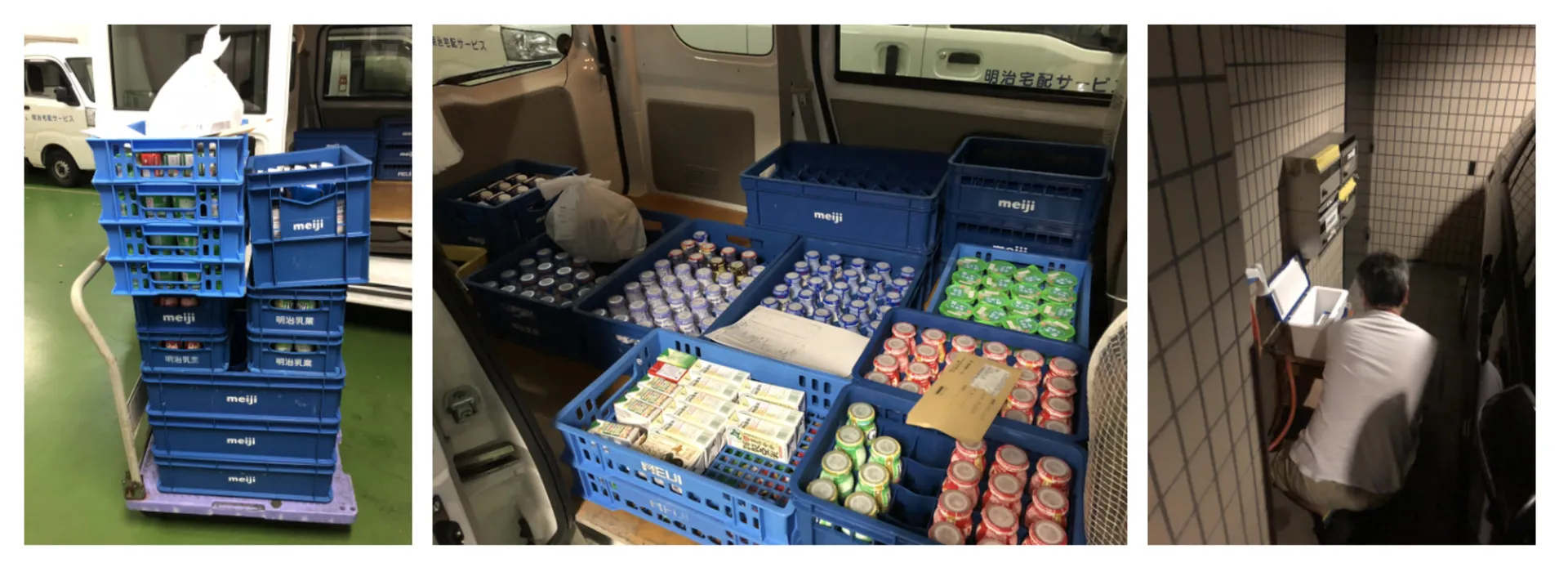
Two members (Hamasaka and Akagi) who joined before they even started yet pushed hard on this project. It must have been quite a surprise to have a brand-new business they'd poured themselves into shut down so quickly.
Stailer: replacing Howl's Moving Castle
The Tabery ordering feature, the deep dives with retailers, the supply chain experiment — digesting all of this made 10X's strategic constraints visible:
- The real bottleneck in Japan's net supermarket market (the market gap)
- 10X's relative advantage — our source of discontinuous change (competency)
- What 10X won't do — hard assets (constraint)
From these three, the product we committed to building was Stailer.
The value for users is straightforward: a dramatically better UX.
For retailers: launch an online grocery without development investment, at speed, with the optimal channel. This aligns their strategy with implementation.
For 10X: compete in our area of strength — strategy and software — while leveraging massive existing supply chains.
A complementary relationship, where both sides are betting on the growth of the net supermarket market itself.

Pricing was a critical design choice. All product and data remains 10X's asset. No upfront fees; a reasonable monthly fee plus revenue share.
Enterprise software typically follows a one-time sale or fixed-fee model. But for consumer-facing software, that governance structure is a terrible fit.
Consumer software requires continuous iteration to keep hitting moving user needs. Under a sell-once or fixed model, all the risk shifts to the enterprise buyer. The SI gets paid whether the product succeeds or not; the retailer gets a system users might not adopt, with no ability to change it. Using Nassim Taleb's framing: not everyone has "skin in the game." Incentives don't align.
Stailer's pricing is designed to fix this. 10X bears all initial development costs and takes all risk. If what we build isn't loved by users, 10X earns nothing. In exchange, 10X takes full responsibility and authority for growth. That governance intent is embedded in the price.
This isn't a new model — Shopify works the same way. But many enterprise systems are like Howl's Moving Castle: complex, black-boxed, nobody fully understands them, but they're running. Stailer absorbs that complexity by building an API layer from the outside, enabling legacy replacement.
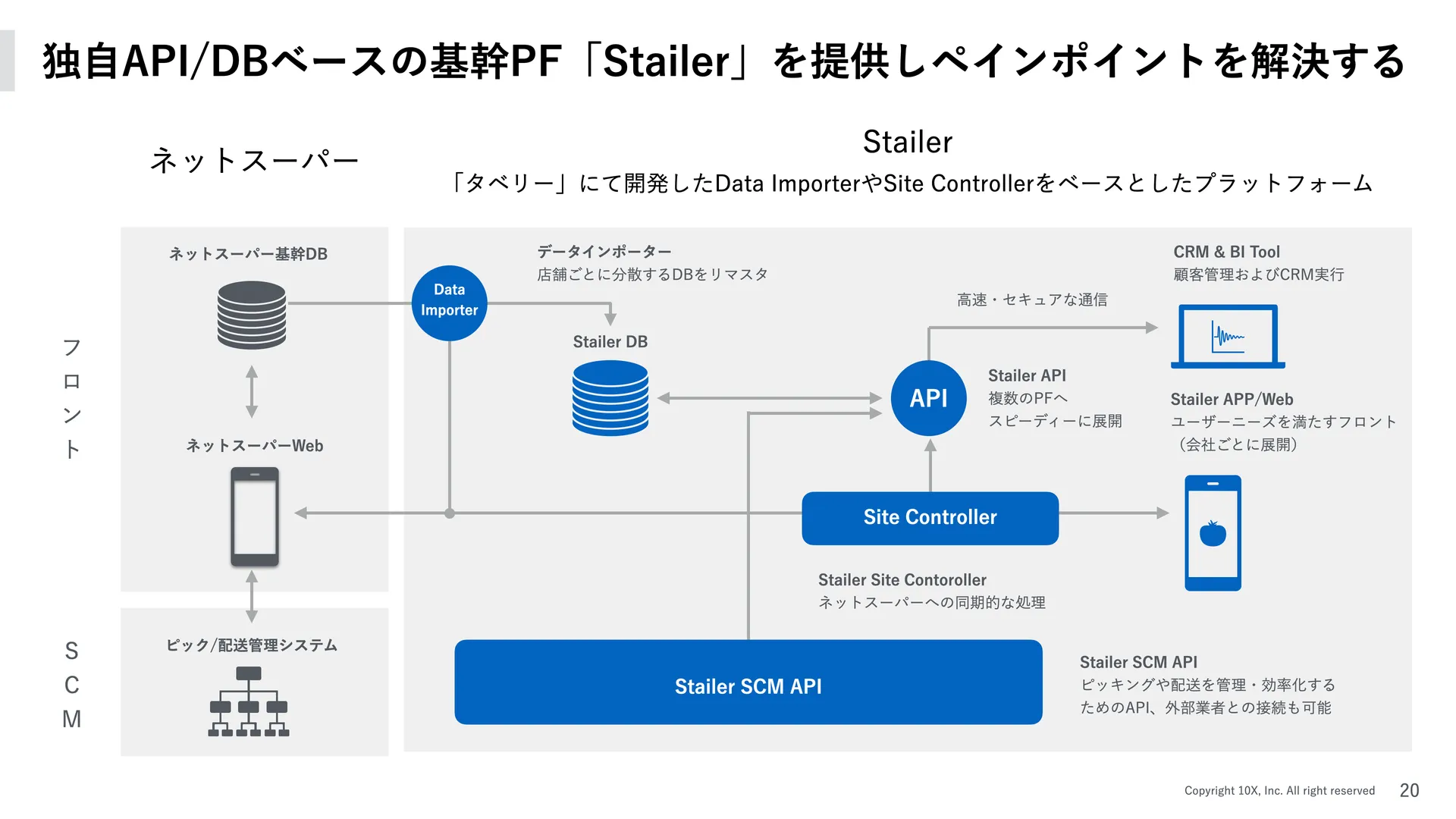
The bet 10X is making on the next decade
A startup's sharpest asset is its hypothesis about which wave to ride. Get it right, and you succeed; get it wrong, and you need a bigger bet.
10X's hypothesis is simple: Japanese supermarkets will go online. Not just fresh produce delivery — supermarkets.
We believe net supermarkets will be one of the most critical pieces of social infrastructure in Japan over the next decade. Supermarkets are the only channel that can deliver the full breadth of SKUs for genuine one-stop shopping. Moving that one-stop experience online requires discontinuous change. 10X believes it can play that role for the market.
Japan's food retail market is ¥64 trillion — enormous. The largest channel is supermarkets (¥13 trillion), but only about 1% is transacted digitally. In South Korea, a more advanced e-commerce market, that's approaching 10%.
Tabery started from a user experience problem: "what should we eat tonight?" Building connections to supply chains revealed the problems retailers face. The Tabekuru experiment revealed just how hard supply chain building is.
Stailer is 10X's maximum contribution to this market right now. Replace the complex systems. Transform the user experience. Build the net supermarket infrastructure Japan needs.
In 2020, COVID-19 forced everyone to reconsider their relationship with supermarkets as social infrastructure. A wave of demand for minimizing physical contact is here. We believe this business matters for society. Build the infrastructure. That's what 10X is betting the next decade on.